Categories: EDUCATION

A 21st Century Learning Model


by Terry Heick

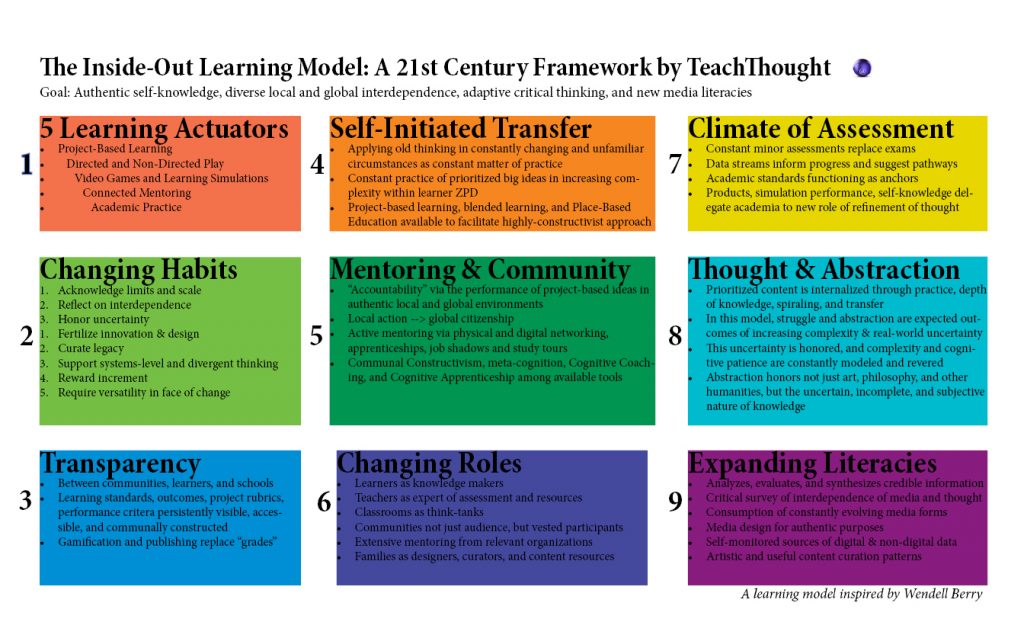
As a follow-up to our 9 Characteristics of 21st Century Learning we developed in 2009, we have developed an updated framework, The Inside-Out Learning Model.

The goal of the model is simple enough–not pure academic proficiency, but instead authentic self-knowledge, diverse local and global interdependence, adaptive critical thinking, and adaptive media literacy.

By design this model emphasizes the role of play, diverse digital and physical media, and a designed interdependence between communities and schools.

The attempted personalization of learning occurs through new actuators and new notions of local and global citizenship. An Inside-Out School returns the learners, learning, and ‘accountability’ away from academia and back to communities. No longer do schools teach. Rather, they act as curators of resources and learning tools and promote the shift of the ‘burden’ of learning back to a more balanced perspective of stakeholders and participants.

Here, families, business leaders, humanities-based organizations, neighbors, mentors, and higher-education institutions all converging to witness, revere, respond to and support the learning of its own community members.

The micro-effect here is increased intellectual intimacy, while the macro-effect is healthier communities and citizenship that extends beyond mere participation, to ideas of thinking, scale, legacy, and growth.

The 9 Domains Of the Inside-Out Learning Model

1. Five Learning Actuators

  • Project-Based Learning
  • Directed and Non-Directed Play
  • Video Games and Learning Simulations
  • Connected Mentoring
  • Academic Practice

2. Changing Habits

  • Well-being (for teachers and students) as a matter deserving of innovation & design
  • Acknowledge limits and scale
  • Reflect on interdependence
  • Honor uncertainty
  • Curate legacy
  • Support systems-level and divergent thinking
  • Reward increment
  • Require versatility in the face of change

3. Transparency

  • Between communities, learners, and schools
  • Learning standards, outcomes, project rubrics, performance critera persistently visible, accessible, and communally constructed
  • Gamification and publishing replace ‘grades’

4. Self-Initiated Transfer

  • Applying old thinking in constantly changing and unfamiliar circumstances as a constant matter of practice
  • Constant practice of prioritized big ideas in increasing complexity within learner’s Zone of Proximal Development
  • Project-based learning, blended learning, and Place-Based Education available to facilitate highly constructivist approach

5. Mentoring & Community

  • ‘Accountability’ via the performance of project-based ideas in authentic local and global environments
  • Local action –> global citizenship
  • Active mentoring via physical and digital networking, apprenticeships, job shadows and study tours
  • Communal Constructivism, meta-cognition, Cognitive Coaching, and Cognitive Apprenticeship among available tools

6. Changing Roles

  • Learners as knowledge makers
  • Teachers as the expert of assessment and resources
  • Classrooms as think-tanks
  • Communities not just audience, but vested participants
  • Families as designers, curators, and content resources

7. Climate of Assessment

  • Constant minor assessments replace exams
  • Data streams inform progress and suggest pathways
  • Academic standards prioritized and anchoring
  • Products, simulation performance, self-knowledge delegate academia to a new role of refinement of thought

8. Thought & Abstraction

  • In this model, struggle and abstraction are expected outcomes of increasing complexity & real-world uncertainty
  • This uncertainty is honored, and complexity and cognitive patience are constantly modeled and revered
  • Abstraction honors not just art, philosophy, and other humanities, but the uncertain, incomplete, and subjective nature of knowledge

9. Expanding Literacies

  • Analyzes, evaluates, and synthesizes credible information
  • Critical survey of the interdependence of media and thought
  • Consumption of constantly evolving media forms
  • Media design for authentic purposes
  • Self-monitored sources of digital & non-digital data
  • Artistic and useful content curation patterns

The Inside-Out Learning Model Central Learning Theories & Artifacts: Situational Learning Theory (Lave), Discovery Learning (Bruner), Communal Constructivism (Holmes), Zone of Proximal Development & More Knowledgeable Other (Vygotsky), Learning Cycle (Kolb), Transfer (Thorndike, Perkins, Wiggins), Habits of Mind (Costa and Kallick), Paulo Freire, and the complete body of work by Wendell Berry

Founder & Director of TeachThought


Source link

Mainedigitalnews.com

Share
Published by
Mainedigitalnews.com

Recent Posts

How Can Forum and Playback Theatre Empower Marginalized People?

By . Natalya Schevchenko and Jane Rozbytska facilitate a conversation about Playback Theatre and Forum…

7 hours ago

Buying big at the trade deadline would be a mistake for the New York Rangers

The New York Rangers have struggled a bit after a strong start to the 2026-2027…

7 hours ago

Nvidia may face more hostile Washington

Chipmaker Nvidia CEO Jensen Huang’s relationship with President Donald Trump probably won’t save the company…

8 hours ago

‘It stopped me quitting acting’: Renate Reinsve on her life-changing role in The Worst Person in the World

Julie was even more special, Reinsve says, because Trier, who she had previously worked with…

8 hours ago

Pollution as Growth Killer

India’s Outlook Business has an excellent issue focusing on pollution not just as a people…

8 hours ago

27 Fun Food Web and Food Chain Activities

Food webs and food chains are key science topics that pop up across the elementary…
8 hours ago