

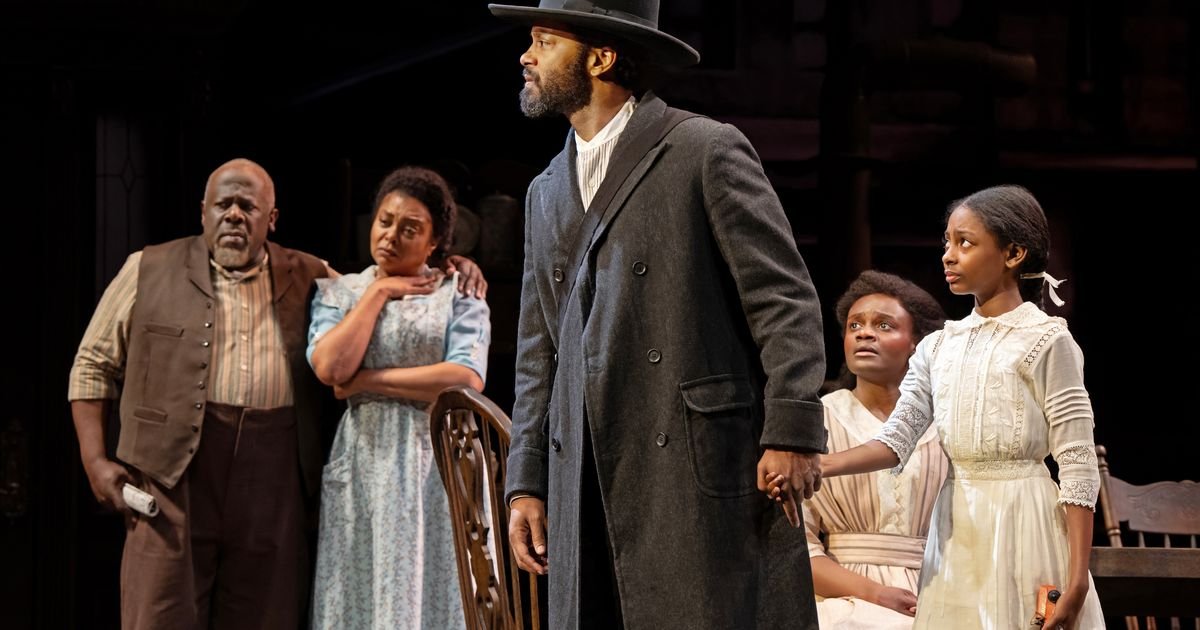

Cedric “The Entertainer,” Taraji P. Henson, Joshua Boone, Nimene Sierra Wureh, and Savannah Commodore in Joe Turner’s Come and Gone, at the Ethel Barrymore.
Photo: Julieta Cervantes
“There are no new August Wilsons,” the late director Marion McClinton once said. “There ain’t going to be any neither.” McClinton knew what he was talking about. Wilson’s was an inimitable voice, and you can hear it rolling like a wave in the Broadway revival of Joe Turner’s Come and Gone. Inimitable, though not necessarily incomparable — listening to the characters that populate the boardinghouse run by Seth and Bertha Holly in Joe Turner, I found myself thinking also of the great Irish playwrights Seán O’Casey and Brian Friel. Like Wilson, they wrote deceptively naturalistic, deeply symbolic dramas, plays that use a mastery of vernacular to conceal — and then unleash with a roar — a roiling core of spiritual ache that lofts working-class lives to the plane of myth. All three writers turned loving, humorous, piercing gazes on a particular place, exploring, through cycles of plays, the rich humanity and the grave historical wounds of its inhabitants. For Wilson, that place was Pittsburgh. Perhaps best to let him introduce it:
“It is August in Pittsburgh, 1911. The sun falls out of heaven like a stone. The fires of the steel mill rage with a combined sense of industry and progress … From the deep and the near South the sons and daughters of newly freed African slaves wander into the city. Isolated, cut off from memory, having forgotten the names of the gods and only guessing at their faces, they arrive dazed and stunned, their heart kicking in their chest with a song worth singing.”
And that’s just a stage direction. Joe Turner is the second play in Wilson’s Pittsburgh Cycle, also called the Century Cycle since each of its ten plays looks at the lives of Black Americans during a different decade of the 1900s. But Wilson didn’t write them in order: Joe Turner came fourth, between Fences and The Piano Lesson — in other words, when he was really cooking. In Debbie Allen’s production, the magnetic Joshua Boone is the smoldering coal that will eventually bring that heat. As stranger-come-to-town Harold Loomis, he’s the dark center in the midst of a flurry of action that his landlords, Seth (Cedric the Entertainer) and Bertha (Taraji P. Henson), strive in their own ways to keep wholesome and light. Persnickety and dollar-conscious but fundamentally goodhearted, Seth is skeptical when Loomis arrives with his single suitcase and his young daughter Zonia (I saw the elfin Savannah Commodore, who shares the role with Dominique Skye Turner). And no wonder: Wilson’s characters bear meaningful names, and Harold Loomis not only heralds unrest to come; he also enters looming, his long shadow filling the glass panes of the boardinghouse door as a series of menacing blues chords ripples on a non-diegetic guitar. In his wide-brimmed hat and dirt-spattered duster, Harold might as well be rolling up to an Old West saloon to shoot the place full of holes.
“Something ain’t setting right with that fellow,” Seth grumbles repeatedly to anyone who will listen. What he doesn’t know is just how deeply true his suspicion is. The slow peeling open of Harold — and the revelation that the pall he carries is not inherent malice but a grievous injury that his soul is struggling to exorcise — is the business of the play. Before we’ve even met the man, Wilson tips us off: Another boardinghouse resident, the “rootworker” Bynum Walker (Ruben Santiago-Hudson in a loose-limbed, nuanced performance that crescendos with the play), has already sung Joe Turner’s first big aria in the opening scene. Chatting with the peddler Rutherford Selig (Bradley Stryker, enjoyably channeling Deadwood), Bynum casually unzips the surface of reality and dips into the waters below. Selig is known for finding people, and Bynum wants his help finding a “shiny man” that he claims to have met once on the road. This stranger led him to a crossroads and, there, a vision: “I looked over and seen my daddy standing there…” says Bynum, soaring somewhere above the Hollys’ breakfast table as he tells the story. “My daddy called me to him. Said … it grieved him to see me in the world carrying other people’s songs and not having one of my own. Told me he was gonna show me how to find my song … I asked him about the shiny man and he told me he was the One Who Goes Before and Shows the Way.” In this otherworldly encounter, Bynum found his “song” — his selfhood, autonomy, and purpose as a healer of souls and patcher-up of societal rifts. “I had the Binding Song…” he declares. “That’s why they call me Bynum. Just like glue I sticks people together.” (Thus the arrival at the boardinghouse of poor Maddie Campbell, played by the excellent Nimene Sierra Wureh, who adroitly balances pathos and levity as an innocent looking for Bynum to help her get back the man who ran away.)
Wilson isn’t a hurried playwright. The yarns of Joe Turner interweave gradually, everyday chit-chat, bargaining, and flirtation interlocking over time with threads of mysticism — both the ghosts of a brutal history and the ancestral spirits that stand protective and defiant like a phalanx of angels with shining swords. Every play in the Century Cycle has its roots in the cataclysm of enslavement, but Joe Turner takes place with Reconstruction still close in the rearview. Even its title, we come to discover, is haunted: Bynum has a habit of starting scenes by singing to himself, and early in the second act, he’s distracting Seth with such a song as the pair play dominoes. “They tell me Joe Turner’s come and gone, ohhh Lordy…” Bynum hums. “Come with 40 links of chain … Got my man and gone.”
The tune is jaunty, but this is the kind of patter that, in Wilson’s work, floats above a grave. That folk song is a record of one of the great underdiscussed crimes of the decades after the Civil War: the legal loophole that allowed for re-enslavement of free men and women as punishment for a crime. In the new South, one scrabbling to industrialize, business owners could now hire unpaid labor through the penal system. The state itself could also put convicts to work after scooping people up for minor or fabricated offenses. The figure of “Joe Turner” had roots in reality, then grew into a mythical devil — king of the chain gang, a literal body-snatcher, one whose name Wilson also mines for meaning: Joe turns “the world upside-down” for his victims, leaves them “all turned around inside,” uncertain “that the world [is] still there.”
The spiritual unease that Harold Loomis brings to Seth and Bertha’s boardinghouse reaches a point of crisis at the end of the first act, with another, still more terrible outburst inevitably on the way. The ultimate scene packs a punch here — without spoiling things, Abigail Onwunali is particularly powerful in a role that Wilson saves till the eleventh hour, and Boone goes to places at once frightening and devastating. But it’s also true that the slow-burn of Allen’s production can sometimes get a little too close to a fizzle. She foregrounds cuteness in the scenes shared by Zonia and a local boy named Reuben Scott (I saw Christopher Woodley, though you might see Jackson Edward Davis), rather than letting the children’s attempts to understand and imitate their haunted elders carry much of their own weight. Most of her staging also maintains a stately wide shot on the Hollys’ first floor, cleaving to Wilson’s veneer of the real so closely that, when she first tries to switch gears and take the physicality of her ensemble to a more heightened realm, some of the audience breaks into giggles. In the same vein, while the top-notch lighting designer Stacey Derosier keeps the show’s backdrop of smoking coke towers and steel bridges attractively washed in pinks and golds, I also yearned for Allen to let her do more to enhance the play’s spectral shivers.
Because what Wilson created with Joe Turner’s Come and Gone is a house of shadows and echoes. What’s been passed down and what will be passed down is a crucial concern, even for the earthier characters like Molly Cunningham (Maya Boyd), a hardened beauty who’s determined not to be like either of her parents, or, in a different vein, Seth, who toils away at his metalwork because a man’s ability to make things is “something can’t nobody take away from him.” (Those smoking factory towers in the distance tell another story — Joe Turner isn’t Seth’s tragedy, and yet there’s one coming for him, too.) In a moment that caused gasps the night I saw the show, Selig cheerfully reveals that his gift for “People Finding” is his inheritance from a great-grandfather who captained a slave ship and a father who was famous for capturing runaways. In this web of ancestries, it’s also notable, though uncommented on, that Seth and Bertha have no children. Henson, who does a lot with a character that doesn’t monopolize the spotlight, touches little Zonia’s hair or steals a subtle glance at her now and then. It’s an untold story, perhaps the reason why the couple have forged themselves as caretakers for all those that wander.
You can keep going — Wilson’s poetry is richly layered, a dramaturgy of abundant significance. The roots are deep, the canopy wide, and the song in the leaves, especially in the hands of an ensemble like this one, always worth rehearing.
Joe Turner’s Come and Gone is at the Barrymore Theatre.