

Getting your audio player ready…
The battlefields of history were not just sites of warfare; they represented the creativity of our military engineers as they invented deadly machines to demolish city walls, sink enemy ships and seize control of the battleground. Ancient texts document the existence of many of these types of weapons, but only a small number of physical examples remain today; thus, any archaeological discoveries associated with these machines are extremely valuable.
Some of the best examples of military technology found are remnants of early artillery, complex designs for crossbows and other advanced weaponry, and also examples that prove the existence of rapid-fire designs that show true technological mastery by our ancestors.
1.Terracotta Army Crossbow
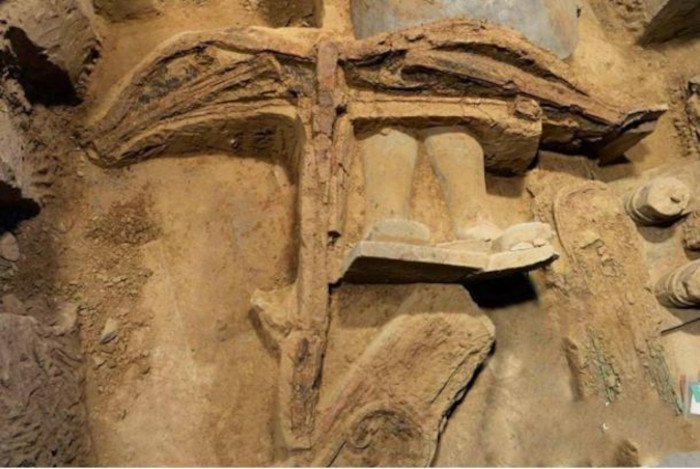
One of the finest examples of military technology from the ancient world is undoubtedly the fully functional crossbow from China’s Terracotta Army. Archaeologists working at Emperor Qin Shi Huang’s tomb in 2015 discovered an incredibly preserved crossbow dating back more than 2200 years.

The most complete ancient crossbow to date was discovered in the terracotta army pit one in Xi’an, Shaanxi province. (Credit: Chinanews.com)
The crossbow was found in Pit 1 and contains a working bronze trigger mechanism and even a string made from animal tendons. As a result of finding this weapon, researchers now have an excellent understanding of the types of crossbows used by the Qin dynasty’s army and how they helped create the unified empire we know today. Due to its advanced design, the bronze trigger enabled rapid-fire capabilities with minimal training for soldiers from the Qin army, which contributed to their strength during combat.
In turn, current examinations of firsthand accounts of testing models with similar design have proven these crossbows were capable of penetrating the armor of their time, which supports the conclusion that the weapons within the Terracotta Army were not only designed for ceremonial use, but were, in fact, fully operational weapons that would be properly utilized during warfare.
2.Xanten-Wardt Manuballista

The Xanten-Wardt frame after conservation. (Maarten Dolmans)
Another astonishing discovery is the Xanten-Wardt manuballista, widely considered the best-surviving example of a Roman torsion catapult. Discovered in 1999 in a gravel quarry in north-west Germany, this first-century AD artifact retained its metal plating and the wood of its frame, providing a clear picture of Roman artillery construction. The Roman ballista was a highly accurate, torsion-powered weapon capable of launching heavy bolts over great distances. The preservation of the Xanten-Wardt frame allowed engineers to reconstruct the machine accurately, proving it was a powerful, winched, stand-mounted weapon, settling long-standing debates about its operation and effectiveness on the ancient battlefield.
3.The Mythical Polybolos
Recent research has confirmed, through physical evidence at the archaeological site of Pompeii, the existence of an ancient Greek weapon known as the polybolos, or repeating catapult. For many years, people believed that this weapon was merely a myth but researchers studying the impact marks on the walls of Pompeii made during the sieges of the city by General Lucius Cornelius Sulla in 89 BC made a breakthrough. They compared the spacing of those impact marks to what had been written about the polybolos by ancient historian Philo of Byzantium. The results showed that the impacts that occurred to the walls of Pompeii corresponded exactly to the range of fire that a polybolos would have achieved. These ballistic impact marks are the first physical evidence found that this weapon was in fact deployed in combat.

Flamethrower for shooting Greek fire, Byzantine Empire (reconstruction). Thessaloniki Technology Museum. (Gts-tg/CC BY-SA 4.0)
4.The Cheirosiphon
Moving to naval warfare, the cheirosiphon is a significant historical weapon housed in the Athens War Museum represents one of the most feared weapons in history: Greek Fire. The cheirosiphon was a portable siphon that could be held in the hand and was used by the Byzantines to shoot Greek Fire, a highly flammable and secret combination of liquids that could continue to burn even when they were on top of the surface of the water. The cheirosiphon was an early type of flamethrower that allowed for the total destruction of enemy ships and soldiers, while it protected Constantinople from many attacks. The exact chemical combination that made up Greek Fire is lost in history, but we can see from the remaining examples of the cheirosiphons how advanced the Byzantines were in terms of thermal warfare.

Iron tips of Roman ballista bolts. (Brunswick State Museum/CC BY 3.0 DE)
5.Utrecht Roman Ballista Bolt
Finally, the uncovering of the world’s first intact Roman ballista bolt in Utrecht, Netherlands adds a tangible reality to the investigation of Ancient Roman siege warfare. Discovered along the banks of the Rhine, the arrow form projectile was preserved in the river’s anaerobic clay. The bolt measures just over half a meter long and weighs an astonishing amount considering it was fired with tremendous velocity from a mobile or stationary catapult. Although such artifacts are relatively simple when compared to the advanced mechanics of Roman military engineering, they highlight the lethal efficiency of these brutal war machines and the deadly outcome that awaited those who had to confront them.
Top image: Roman siege scene with a large ballista catapult in the foreground. Source: AI-generated illustration / Ancient Origins
By Gary Manners
References
Arnold, P. 2026. Pompeii’s battle scars linked to an ancient ‘machine gun’. Phys.org. Available at: https://phys.org/news/2026-03-pompeii-scars-linked-ancient-machine.html
ECNS News. 2015. Complete Crossbow Found With China’s Terracotta Army. Archaeology Magazine. Available at: https://archaeology.org/news/2015/03/20/150320-china-qin-crossbow/
Rossi, A. et al. 2026. From Pompeii to Rhodes, from Survey to Sources: The Use of Polybolos. Heritage. MDPI. Available at: https://www.mdpi.com/2571-9408/9/3/96
Wilkins, A. The Xanten-Wardt Roman torsion catapult and catapult parts from Carlisle. RomanArmy.net. Available at: http://www.romanarmy.net/pdf/The%20Xanten-Wardt%20and%20Carlisle%20catapult%20finds.pdf