
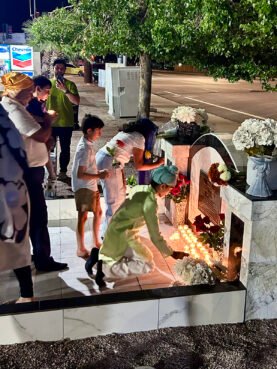
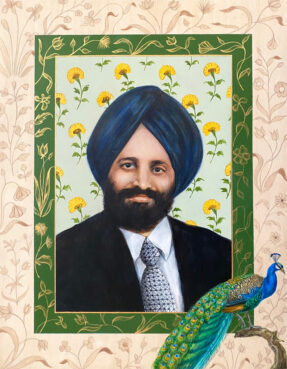
(RNS) — Every year since 2001, the family of Balbir Singh Sodhi has held a solemn ritual: a vigil to honor the Sikh immigrant, gas station owner and father of five believed to be the first person killed in a hate crime after 9/11. Sodhi was planting flowers in front of his gas station in Mesa, Arizona, to honor the victims of the terrorist attacks when he was shot five times.
The man convicted of the crime, Frank Roque, had seen Sodhi’s turban and long beard — both important symbols of faith for Sikh men — and mistaken him for an Arab Muslim in the days following the attacks. Roque, enraged by footage of 9/11, had reportedly told an Applebee’s waiter he was going to “shoot some towel heads.” When police arrested him after the shooting, he shouted that he was a patriot.
A quarter-century after Sodhi’s killing forced the country to start to reckon with anti-Sikh hate crimes, advocates say the threat has not faded — rather, it has been amplified by the federal government. Last week, the Department of Homeland Security posted, then deleted, an AI-generated image mocking a Sikh truck driver. It came as an analysis of FBI data finds that anti-Sikh hate crimes rose about 25% between 2024 and 2025, from 142 to 177, even as the overall number of hate crimes in the United States declined.
For some Sikh advocates, this year’s vigil served both as a memorial for Sodhi and a display of interfaith solidarity in the face of rising anti-immigrant sentiment.

On Tuesday (Sept. 15), the family held its 25th vigil for Sodhi in front of his gas station in Mesa, Arizona, organized this year in partnership with the Sikh Coalition, the nation’s largest Sikh civil rights organization, and the Revolutionary Love Project, a nonprofit that promotes community-building through an “ethic of love.”
Sodhi’s relatives and friends, musicians and a dozen faith leaders representing Sikhism, Islam, Hinduism, Christianity and Judaism attended, speaking about what they see as Sodhi’s legacy of unconditional love, rooted in Sikh principles.
“While we could not prevent this gas station from becoming part of the map of hate violence in America, that is not the only story this place holds,” said Deepa Iyer, a senior director at the Building Movement Project, which guides nonprofits using research practices. “Look at what has bloomed here and spread everywhere: a site of remembrance and conscience, a community of care and a future where everyone belongs.”
The Sikh Coalition, one of the vigil’s organizers and a national Sikh civil rights organization, was founded in the days after 9/11 when Sikhs were conflated with widespread images of Osama bin Laden; the group said it recorded more than 300 instances of physical or verbal attacks against Sikhs in its first month of existence.
Advocates say the climate remains difficult for Sikh Americans. People “tend to fear what we don’t know,” said Rucha Kaur, a managing director at the Sikh Coalition who leads Sikh awareness sessions for schools, law enforcement, healthcare providers and other sectors. “When I go out and talk about Sikhs and our practices and our beliefs, there are so many common threads. I think that brings us all closer together.”
The DHS post about Sikh truck drivers came amid growing concern about xenophobic federal rhetoric. It showed an AI-generated image of a transformer facing off against a Sikh man with the words “self-deport or find out” and “get off our roads, you don’t know how to drive, Mr. Singh.”
The North American Punjabi Trucking Alliance estimates roughly 150,000 Sikh long-haul truck drivers work in the United States, making up 40% of California’s truck transport workforce and 20% of the country’s truck transport workforce overall. The Sikh Coalition argues that there is no evidence showing immigrant truck drivers cause more accidents. Data from at least some states, in fact, shows the opposite.
The DHS post caused panic among some Sikh Americans who feared violent fallout from the targeted language. DHS did not immediately respond to a request for comment, but it previously said the now-deleted post was describing a specific person who was “an illegal alien from India who should never have been in our country.” Singh is a near-universal surname adopted by Sikh men as a rejection of the caste system and a symbol of equality.
“An official government agency should not be targeting a whole group of people,” Rucha Kaur said. “We’ve seen over all these years how that kind of profiling only leads to more hate and more fear in our society.”
Sodhi himself had emigrated from India after Prime Minister Indira Gandhi was assassinated by two of her Sikh bodyguards, setting off a wave of brutal anti-Sikh riots. Born in Punjab two years after the British partition of India, he was surrounded by recollections of the mass migration and communal violence that followed — violence that caused an estimated one million deaths, many of them in Punjab. In the United States, his family said, he chased the American Dream, working at a 7-Eleven and driving a taxi before buying a gas station in Arizona. His family and friends have described him as generous, saying he would give out candy to children and free gas to those in need.
Sodhi’s family has stated that they have worked to build bridges since his death, believing they are carrying on his spirit.

Fifteen years after his brother’s murder, Rana Singh Sodhi called Frank Roque, whose death sentence had been commuted to life in prison. On the call, when Roque apologized for his crime, Rana told him he had already forgiven him.
“Forgiveness is not forgetting. Forgiveness is freedom from hate,” said Valarie Kaur, founder of the Revolutionary Love Project and a family friend of the Sodhis. (She is not related to Rucha Kaur at the Sikh Coalition.)
When Roque died in 2022, Rana Singh Sodhi reached out to his family with condolences.
At Balbir Sodhi’s memorial, the service stressed unity: a Baptist preacher sang “Wade in the Water,” and Sikhs in the audience joined in. When Balbir Singh Sodhi’s widow came to the stage in tears, organizers embraced her and reminded her she was surrounded by love. The gas station’s lights shone bright behind them.
Valarie Kaur called on those gathered to carry that spirit forward: “What if we made the values that Balbir Singh Sodhi died for — the values that his brother and his family have lived for — our north star? What if we too chose to leave no one outside our circle of care? What world might we leave our children 25 years from now?
“If this family can sing a song of a revolutionary kind of love, then so can we.”