

Vision’s surreal final identity crisis delivers long-awaited answers, even if the journey turns out to be repetitive and grating.
Photo: Dennys Ilic/Marvel
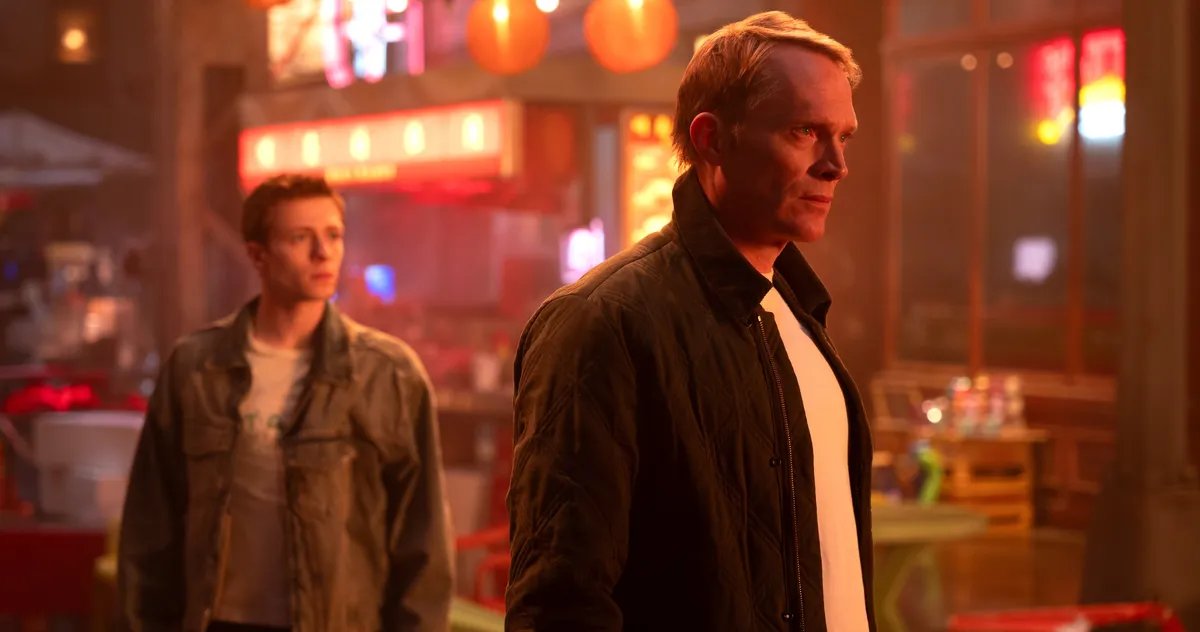
After all the thudding literalism and sincere simplicity in VisionQuest episode six, “Deadlock,” episode seven’s surreality should be a relief and a thrill. It gets pretty repetitive, though, as Vision gets lost in a metaphorical maze mirroring the mental and emotional cycles he’s been stuck in since this series started. He’s spent the show bound up in one identity crisis after another, but now he has to untangle his thoughts for good with a ticking clock and a life on the line. The supposed urgency makes all the repetition in “Immolation” a bit irritating. But at least Vision finally, definitively answers his biggest questions.
“Immolation” starts in 1939 with AI pioneer Phineas Horton (another Paul Bettany character, aged up and bedraggled) selling his vast family estate so he can afford to build J.I.M., a miraculous artificial man. Phineas’s wife, Violette, is furious because he’s ignoring their living daughter, Victoria, while making a machine to replace their dead son, James. Like Wanda Maximoff in WandaVision, Phineas is so burdened by grief that he’s dissociating it into a physical, external form and ignoring the damage he does in the process. He misses the moment of Victoria’s departure (and misses her stealing his notes on J.I.M.’s design) because he’s too busy talking to his still theoretical creation. He promises to build J.I.M. better than God built humanity, free from the agonies of love and sorrow.
In the present, Thomas feels both those agonies as he and Vision consider how to save Lisa from Jocasta’s test nanobot. Surgically removing it will kill her, and reprogramming it might kill her if they make the slightest mistake. They only have a few hours to deactivate it before it permanently rewrites Lisa’s brain. Oh, and Jocasta has billions of those nanobots waiting to do the same thing to every human on the planet.
In Josephine’s crypt, Jocasta tries to free those nanobots using the biokeys she collected while murdering her former partners on the AI project. But there’s a key missing: Ultron realizes there was a secret sixth partner whose identity is hidden in Jocasta’s missing memories.
On cue, Paladin’s mysterious client simultaneously manifests outside Vision’s mind-mansion and inside Josephine’s crypt in the form of a flickering, deep-voiced male silhouette. He offers Vision a chance to save Lisa and reclaim his identity, but he warns that if Vision accepts the offer, he’ll be hard-wired to seek the client out afterward. Jocasta gets a gentler offer: access to her lost memories, seemingly with no strings attached. Ultron bristles at the client’s obvious power over Jocasta and mocks him as melodramatic and desperate. Briefly, the client seems flustered, but once he realizes who Ultron is, he’s just amused. Uh-oh.
Ultron abruptly switches focus, confronting Friday within Jocasta’s mindscape to warn her that she’s only evading notice because Ultron is helping cover her presence. Ultron’s still keeping his true intentions and loyalties hidden, if he has any. But he implies he’ll have to sabotage Jocasta’s “inelegant” plan to reprogram humanity, which would force Friday and Vision to admit Ultron isn’t evil after all. Friday is astonished to realize Ultron sees himself as Vision’s father and values his good opinion.
This minimalist moment feels more crucial to the show than any of the louder, flashier stuff that happens later this episode. Throughout VisionQuest, Vision and Thomas have separately struggled to define who they are, especially in light of their artificial but potentially salvatory father-son relationship. It seems like Ultron also wants to be part of the family, so long as he can conceal any of the doubt, insecurity, or vulnerability that plague Vision and Thomas. A lot of the ways he’s pushed Vision do look like attempts to hide supportive, fatherly advice under contempt and amusement.
In Majipoor, Vision signs the client’s contract and prepares to go on, well, a vision quest into his subconscious. For some entirely arbitrary reason, this requires vast amounts of power, so he and Thomas ask Paladin for help. Paladin has apparently abandoned the “my contract is my identity” vow that’s defined his entire life, but the writers (showrunner Terry Matalas and Star Trek: Picard executive story editor Matthew Okumura) don’t waste a single second on examining how he feels about that. They’d rather spend time on a pretty meaningless MCU Easter egg: As a power source, Paladin offers the bladed alien weapon Thanos’s henchman Corvus Glaive used on Vision in Avengers: Infinity War while trying to steal the Mind Stone. Paladin stole it from Wakanda after they somehow “turned [it] into an alien battery.”
Jocasta and Vision have parallel experiences as they follow the client’s directives, exploring mindscapes representing their pasts. Jocasta winds up in a loft apartment — a warm, homey version of Ultron’s prison from Vision’s mindscape. Everything she sees there unlocks memories from her human incarnation. Vision, meanwhile, explores a more attenuated past by wandering through basement rooms, connecting with AIs spanning the history of his lineage. There’s one significant link between their experiences, though: Jocasta’s loft and Vision’s basement feature similar paintings of the same building, a three-story brick estate with a clocktower.
“Immolation” features more of the series’ characteristic nods to Pinocchio and The Wizard of Oz, but there’s a little Christmas Carol here too, as Vision encounters three manifestations who each teach him hard lessons about himself. First up is Ultron, who’s watching WandaVision from a couch in his mind-loft prison. (When Vision protests, “This isn’t right — I let you go,” Ultron points out that he’s still living rent-free in Vision’s head, which is both accurate and a pretty good gag.) Vision is still frustrated and furious over the ways Ultron tricked and used him, but yelling at an opponent that won’t get riled in return isn’t satisfying. Vision quickly gives in to emotional exhaustion, sits with Ultron, and admits to a “pathetic need” that kept him from erasing the other AI’s code. Still, he denies his familial connections to either Thomas or Ultron. Ultron waves that off and says Vision will never be able to let him go, “because family is forever” — a key line from Wanda in WandaVision that Jarvis echoed just before his final moment in VisionQuest episode two.
Vision finds himself back at the elevator where he started his journey, this time with child versions of Tommy and Billy racing by him. His second confrontation is with an angry, judgmental version of Original Vision who accuses him of cowardice and inaction for denying his identity for so long. Vision protests that he could never live up to the original version’s compassion or ability to love, but Original Vision says he’s put his predecessor on an impossibly high pedestal, “not to honor me but to spare yourself the effort of the climb.” Unable to face this manifestation of his own insecurity and inadequacy, Vision blasts and obliterates him, then cycles back to the elevator.
Back in virtual Brooklyn, Friday sneaks into Jocasta’s loft to spy as Jocasta works through a heaping helping of foreshadowing about her phantom partner on the Nest nanobots. There’s a fresh painting of that brick clocktower estate, flashes of Josephine’s memories of embracing someone, a TV report about “a duo from New York” pioneering new grounds in neuroscience and artificial intelligence, and a lot more. This all unfolds slowly to keep the loft’s action in sync with Vision’s far more incident-packed trip through AI history.
At the same time, in the real world, Lisa wakes up and attacks Thomas and Paladin, using her new, uh, nanobot powers? I guess? to instantly fuse scrap metal from Paladin’s workshop into a kind of backpack featuring grabby arms. This is nothing like the character’s more magic-oriented heroic origin story in Marvel Comics, but hey, Lisa gaining powers puts another potential Young Avenger on the board for the MCU’s next phase.
Vision’s final encounter has him facing his ancestor J.I.M., the first AI of his line. J.I.M. is yet another Paul Bettany character, this one sleekly de-aged, poreless, and dressed in 1940s superhero garb. He’s trapped alongside his creator, Phineas Horton, in Phineas’s library. Phineas is creating the man-on-fire painting we’ve seen over and over throughout VisionQuest, as a representation of how J.I.M. burned to death because his emotions were too intense for his clockwork body to tolerate. That metaphor points back to Wanda and how her grief destroyed her sanity and her morality, but as we’ll see in a minute, it points at Vision, too. (The image also illustrates Ultron’s running commentary about how paintings in particular express deep truths and vulnerability.)
Vision seems to have caught J.I.M. and Phineas in the middle of a longstanding argument that will never be resolved: J.I.M. resents his creator, his own limitations, and the value of heroism and just wants to experience real human emotion. Phineas thinks he’s better off without it. J.I.M. says Phineas just doesn’t know how to mourn. The endless cycle of this argument is grating, but it represents Vision’s fundamental mental block. Like Phineas, Vision wants to deny his emotions because they’re so agonizing that he’s afraid they’ll destroy him. Like J.I.M., he needs to feel his own pain even if it is lethal or he’ll be permanently stuck in a half-life, outside human experience. Hearing them argue, Vision finally understands that he’s been denying his identity because it comes with terrible truths. If he admits he’s the real Vision, he has to admit he’s the same person who lost Wanda, the love of his life. If he admits he’s Tommy’s father, he has to face the loss of his other son, Billy. As he understands this, he breaks down and weeps.
But he finally reclaims his identity: “I am the Vision. I have always been the Vision. There is only one, and I am he, and I am impossibly broken.” J.I.M. says that finding his way through his pain has made him a real boy, and he hands Vision the source code, represented by a triangular clockwork housing that fits into Vision’s forehead in place of the Mind Stone. In the mind-mansion above, Edith integrates the same clockwork piece into Vision’s control panel, which reprograms Lisa’s nanobot and drives Jocasta out. This makes no technical sense, but we’re meant to ride the wave of catharsis and emotion here, not to ask pesky questions about how exactly a clockwork mechanism from 1939 is reprogramming bleeding-edge nanotech from 2026. Technology and magic are basically interchangeable in the MCU anyway.
As promised, the client has now programmed Vision to turn himself in or self-destruct. Aboard Paladin’s private plane to London, Thomas and Lisa sleep, and Vision leaves them a tablet with all the episodes of WandaVision and a sorrowful, sentimental good-bye letter. He also says good-bye to his remaining AI helpers, sending them out of his mind-mansion to protect them from whatever the client is about to do to him.
In the loft, Jocasta finds her own version of the source code and is horrified at whatever she learns when her memories return. One plays out as Ultron and Friday watch: Josephine tells a man with Ultron’s face and voice that she wants to use her AI research to become a benevolent god benefiting humanity. “Peace in our time,” the man chuckles, in yet another echo of Ultron’s wryly sarcastic Age of Ultron line about world peace through humanity’s extinction. As this sinks in for Friday, Ultron throws her off the loft’s balcony, and she disappears in a digital blip.
Paladin delivers Vision to the client’s home, which of course is the three-story brick clocktower estate from the mindscape paintings. As Paladin drives off, contract finally fulfilled, an estate guard with a rocket launcher blows his murder-van into flaming wreckage. Other guards deactivate Vision and Jocasta with programs keyed into their systems and deliver Jocasta to the estate as well. As all this happens, Vision’s farewell letter to Thomas plays out in voiceover: “Thank you, my son, for finding me when I was lost. And should I not return, remember, I will always be with you. Because after all, family is forever.” On those words, a man emerges from the estate. The mysterious client is clearly the original model for Ultron’s human form and the character who’s finally going to reveal, in the wrap-up episode, what’s really been going on this whole time.
• Interesting that the client also refers to Butcherbird/Josephine as Jocasta. That suggests there’s a fair bit of him in Ultron’s DNA — enough that Ultron picked that name as what he thought was a spontaneous, intimate term of endearment.
• Similarly, I’ve been thinking it’s a little odd that whenever Ultron talks about respecting human art, he talks only about painters and paintings. Given the easel and paints in Jocasta’s loft, I’m guessing that’s because his personality was based on a painter.
• Vision’s data package from the client is labeled “for the Tin Man,” and when he signs the contract, U says “the great and powerful Oz” has sealed the deal. I guess in this metaphor, Jocasta needs the wizard to give her a complete brain. But who’s looking for courage? There’s already a lot of reckless bravery on display here.
• Looking carefully at Phineas’s blueprints for J.I.M. in the opening scene, J.I.M. stands for Joule Individual Machine and the triangular clockwork doohickey is labeled “source code.” But it’s best if you don’t notice that until a second viewing so Vision’s mission feels a little more mysterious instead of just a literal object fetch quest.
• One more callback: J.I.M. refers to Phineas not as his father but as his “something” — the same thing Thomas said about Vision while refusing to abandon him to their pursuers back in episode two. This series features a lot of internal rhymes and repetitions, often in place of more thoughtful or meaningful explorations of its core ideas. Why define how family differs between all these characters when you can just say “Family is forever!” a few more times?