

Getting your audio player ready…
Archaeologists working in Grenoble, France, have made a chilling discovery that sheds light on the brutal religious persecution of the 16th century. The remains of a rare Renaissance-era gallows, along with at least 32 individuals who were executed and denied proper burial, have emerged from beneath the Boulevard de l’Esplanade. The site offers a haunting glimpse into the dark period of France’s Wars of Religion, when public execution served as both punishment and warning to those who dared challenge authority.
A Gibbet Emerges from the Flood Plains
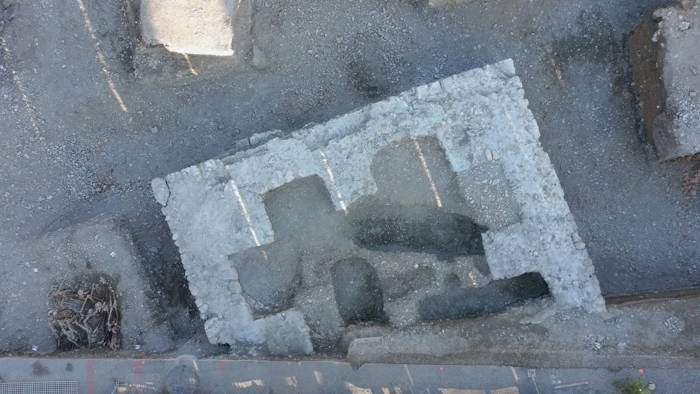
The excavation site sits on land gradually reclaimed from the flood-prone plains where the Isère and Drac rivers meet. For centuries, this marshy terrain remained on the outskirts of Grenoble, exploited for its sand and wood before eventually becoming integrated into the expanding city. Researchers from France’s National Institute for Preventive Archaeological Research (INRAP) discovered a quadrangular masonry foundation measuring 8.2 meters per side, initially puzzling over its purpose. Surrounding this stone structure lay ten burial pits containing human remains in various states of disarray – bodies thrown carelessly without orientation, funerary rites, or dignity.
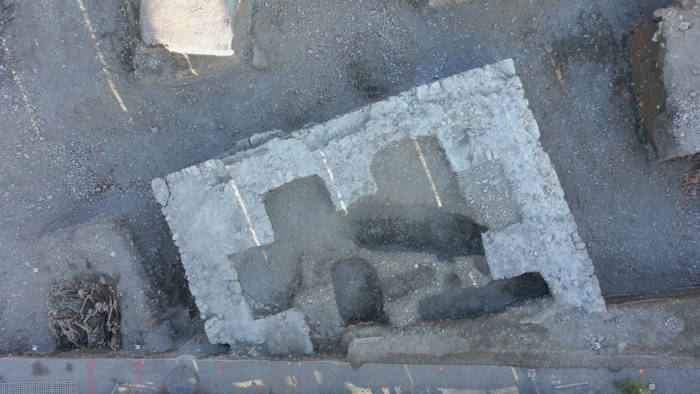
Aerial view of the gallows at the end of the excavation. (© Nordine Saadi/Inrap)
Historical construction records from between 1544 and 1547 eventually revealed the structure’s true identity: the Port de la Roche gibbet, Grenoble’s historic gallows. This wasn’t simply an execution site but rather a display platform where bodies were hung after being executed elsewhere in the city. The structure consisted of eight stone pillars supporting a timber framework that rose approximately five meters high, creating a grim landmark visible to all who entered Grenoble through its northern gate.
The Significance of Eight Pillars
The number of pillars on a gibbet held profound significance in the judicial hierarchy of Renaissance France. Local courts typically erected gibbets with two to six pillars, while the infamous royal gallows at Montfaucon in Paris boasted sixteen. Grenoble’s eight-pillar structure reflected the city’s importance and the authority of its courts. The elevated platform, protected from flooding by its position and surrounding drainage ditch, ensured the displayed bodies remained visible for extended periods – a deliberate choice meant to maximize the deterrent effect on the population.
Those condemned to death were first executed publicly within Grenoble’s city center at the Place aux Herbes, where crowds could witness the spectacle. Only then were their bodies transported to the gibbet outside the city walls for display. Judicial archives identify some victims whose remains may lie within the discovered burial pits, including Protestant rebels such as Benoît Croyet, accused of attacking Grenoble in 1573, and Charles du Puy Montbrun, the Huguenot military leader of Dauphiné, who was beheaded and displayed at the gallows in 1575 after his capture by Catholic forces.
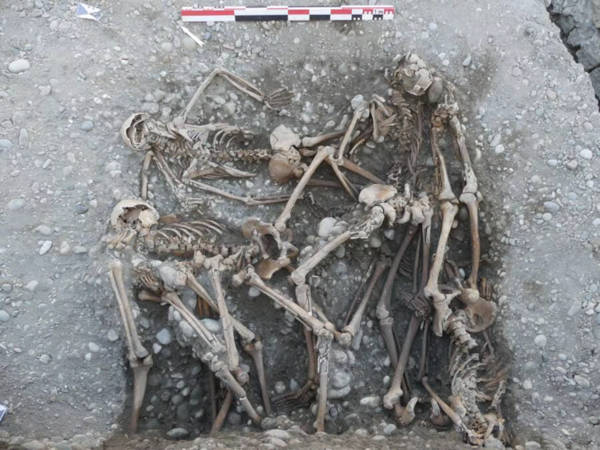
Multiple individuals buried without care in one of the discovered pits. (Anne-Gaëlle Corbara/INRAP)
Burial as Extended Punishment
The burial practices at the site reveal the full extent of the condemnation. “They are buried without any care, without any care in the ornamentation and in the way of managing,” archaeologist Nicolas Minvielle-Larousse told All That’s Interesting. “The bodies can be moved, mutilated and put back in other places.” Among the 32 individuals—30 men and two women—at least one showed clear evidence of decapitation. Bodies were thrown into pits, sometimes dismembered or rearranged, deliberately denying the condemned proper Christian burial and extending their punishment beyond death itself.
This treatment reflected the belief that denying proper burial was a fate worse than death, condemning the soul to eternal unrest. Such infamy served multiple purposes: it satisfied public demand for harsh justice, reinforced the authority of the state, and sent an unmistakable message to anyone considering rebellion or heresy. The varying positions of the bodies—some on their backs, others face down, many jumbled together—suggest they were disposed of without ceremony whenever space became available or when the decaying remains needed to be cleared from the gibbet above.
Religious Conflict and the Wars of Religion
The timing of the gallows’ construction coincided with one of the bloodiest periods in French history. The French Wars of Religion, which ravaged the country from 1562 to 1598, pitted Catholics against Huguenots (French Protestants) in a series of brutal conflicts that claimed hundreds of thousands of lives. Grenoble, strategically located in the Dauphiné region of southeastern France, became a hotspot of religious tension and violence. The discovery of this execution site provides rare physical evidence of how justice—or more accurately, persecution—was administered during this turbulent era.
The gallows likely fell out of use in the early 17th century as political tensions gradually eased following the Edict of Nantes in 1598, which granted Huguenots substantial rights and freedoms. As Grenoble expanded and the marshland was drained for development, the gallows site was eventually buried beneath layers of alluvial deposits and fill dirt. INRAP researchers continue analyzing the skeletal remains to learn more about the lives and deaths of these condemned individuals, potentially revealing information about their age, health, diet, and the precise circumstances of their executions almost five centuries ago.
Top image: Multiple individuals buried in a pit by the gallows. Source: Anne-Gaëlle Corbara/INRAP
By Gary Manners
References
INRAP. 2024. Découverte d’un gibet du XVIe siècle à Grenoble. Available at: https://www.inrap.fr/decouverte-d-un-gibet-du-xvie-siecle-grenoble-20439
Milligan, M. 2025. 16th-century gallows discovered in Grenoble. Available at: https://www.heritagedaily.com/2025/12/16th-century-gallows-discovered-in-grenoble/156592
Harvey, A., 2025. At Least 32 Skeletons Have Been Found At A 16th-Century Gallows In France Where The Dead Were Publicly Displayed After Execution. Available at: https://allthatsinteresting.com/grenoble-france-renaissance-gallows