


At Playwrights Horizons, each slim program comes stuffed with a copy of the theater’s in-house literary magazine, a collection of supplemental essays, interviews, and “playwright’s perspective”s called Almanac. Read one front to back and you get a Thanksgiving dinner’s worth of context, along with a real sense of just how much talking and thinking and self-questioning and self-justifying goes into making any given play. Take No Singing in the Navy, Milo Cramer’s semi-sweet deconstruction of the American sailor musical, now getting its premiere at Playwrights’ upstairs theater: In Almanac’s telling, its “riff on the wide-eyed patriotism of mid-century American musicals” is a deep, “subversive” engagement with the myth of Golden Age innocence and the “sour taste” of the “twisted romance between American imperialism and Broadway.” It’s also a celebration of doing something “wrong” (“a show so rag-tag, so rickety, so intentionally abrasive and pitchy in its presentation … cannot possibly qualify as an American musical!”). And it’s “about grief” — “an existential melancholy buddy company” that grew out of a loving, long-term collaboration between its playwright and its three actors, who all went to grad school together in San Diego amid the docked warships and fighter jet drills.
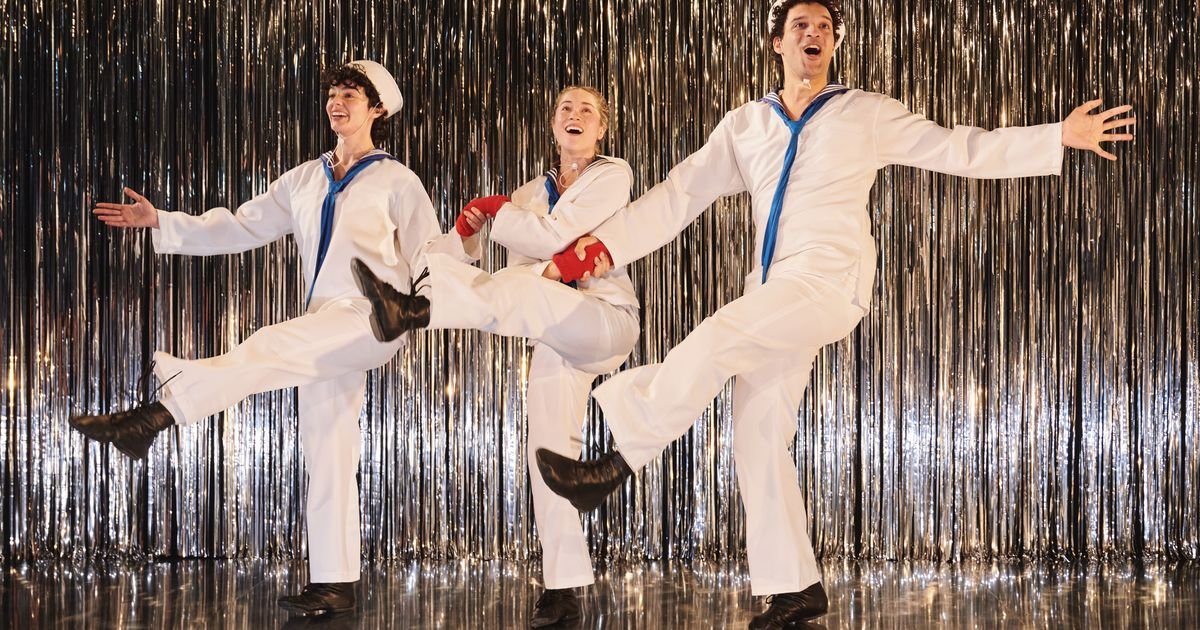
The issue with this much intellectual scaffolding around a play is that it can blur your impression of the thing itself, convincing you that the building is sturdier than it really is — or that it’s one shape when in fact it’s another. That’s not to say that No Singing in the Navy lacks heart. Its chief delight is its trio of performers, each one a super-game, wonderfully distinctive clown with a whole range of bodies and voices (pitchy only when it’s on purpose) at the ready. The physical buoyancy and unfakeable chemistry shared by Bailey Lee, Elliot Sagay, and Ellen Nikbakht (playing Sailors 1, 2, and 3 respectively, plus an onstage costume rack of supporting roles) is enough to keep the show bobbing along, and there’s always a zing of pleasure when director Aysan Celik infuses their zaniness with touches of Jerome Robbins or Stanley Donen. (Like Anchors Aweigh and On the Town, No Singing is built around the antics of a set of sailors on shore leave before they ship out.) But there’s also something keeping the premise from cartwheeling into transcendence. In its essence, the show’s not quite about what it thinks it’s about. It’s surrounded by big, fascinating ideas rather than functioning as a source of them.
“Where does self-worth come from?” sings Sagay wistfully around halfway through the play. (At this point, he’s playing a character known as the Lighthouse Lady: Yes, she wears a lighthouse on her head, but really she’s the archetypal Penelope, waiting faithfully for her soldier while he’s away at war.) “Does it come from deep inside? / I’m not even convinced / that I have a deep inside?” Cramer often uses question marks to give statements a wobbly quality, and in this case, the Lighthouse Lady’s spiritual quandary is also an echo: Early on, the sailors meet a plucky talking crab (Lee, being very cute while wide-squatting in red mittens) who, engaged in her own heroine quest, encourages them to defy the “one rule” (it’s in the title) instituted by their leering, cigar-chomping captain (Nikbakht, with a top-notch squint). The ability to cheer themselves up, the crab insists, comes from “somewhere deep inside your body.” “I’m not even sure I have a deep inside my body,” Sagay’s Sailor 2 trembles.
The true preoccupation of No Singing in the Navy is reflexive: The show is in an anxious wrestling match with itself, attempting to untangle a knot of insecurity around its own capacity for profundity. All-singing, all-dancing American optimism-cum-militarism isn’t really the play’s subject so much as its mode. What it’s really concerned with is its own silliness.
In one of those Almanac interviews, Celik notes that for her, this “silliness is about survival.” That notion — the idea that an avoidance of seriousness is a kind of willful self-protection — reaches its peak as Sailors 2 and 3, almost at the end of their leave, mourn that they are, perhaps, “Too Silly”: “My whole life / I been too silly for most stuff,” sings Sailor 2. “I’m too / Silly to have children,” sings Sailor 3. “Too / Silly to accept / Responsibility / For anything,” they sing together. Moments earlier, the sailors had been at the “the-A-ter,” and Nikbakht, embodying the entire play-within-a-play with an Elizabethan ruff and a tragic demeanor, stars the meta shenanigans by pondering, “Do I really have a soul? / Or am I too silly?”
It’s legitimately funny to watch Sagay’s Sailor 2 storm out of the show (supposedly a play about — what else? — sailors) huffing, “What a load of baloney! That’s not what it’s like to be a sailor at all, they got it all wrong!” But while that’s a good joke, it doesn’t quite weigh even in the scales with the amount of self-doubt, savvy or otherwise, that’s crowding the hold of Cramer’s play. In No Singing’s eleventh hour, a baby-voiced “nameless orderly” played by Lee barks at the sailors when they return from leave that it’s time for “war war war war war war war!” In a squeaky treble, all her rs mushed into ws, Lee builds into a talk-sung, Music Man–style chant of deadly contemporary weaponry: “AK-47 / Paladin tank / Shoulder-fired anti-tank guided missile / A.I.-controlled long range drone…” It’s queasy-making because it can’t not be, but the heart of it isn’t blistering sociopolitical satire; it’s a specific kind of artist-millennial panic. Are we all just fiddling while the world burns? What do we do with all our well-educated impotency? Are laughter and lightness merely opiates, or tools of the revolution, or both, or neither?
Celik seems attuned to such questions as a valid (if not necessarily revelatory) core for a play to circle around, but Cramer’s writing often feels caught between an exploration of comic diffidence and simply an expression of it. At the same time, their dependence on repetition and intentional naïveté starts to wear thin. When Betty Comden and Adolph Green and Meredith Willson are on the mood board, you’re not just in conversation with their historical contexts and theatrical tropes but with the sparkle and agility of their lyrics. Nikbakht’s grizzled captain gets two private interludes in which he confesses to his un-platonic obsession with his men: “My own desires … disturb me,” he growls, and it’s an easy laugh (a little too easy, I think), but his dark night of the soul never amounts to more than a few basic questions reiterated with growing angst. “Is it wrong? To love a sailor? … What does it mean? To love three silly sailors? And is it wrong?” Nikbakht gives it 110 percent, but with the nimble ghosts of “Come Up to My Place” or “I Can Cook, Too” hovering, the material can’t help feeling a little lackluster.
A few years ago, I was completely swept up by Cramer’s School Pictures, a solo musical meditation (Cramer performed it too) on teaching and learning and growing up — and various vexed institutions in which it all happens — that drew on its creator’s experience as a high-school test-prep tutor. Perhaps part of that show’s crystalline solidity came from the children’s voices it evoked: Beautifully observed and idiosyncratic, they let Cramer speak in dialogue rather than monologue. They kept the show outward-gazing, its quirks both earned and honed, its wit elucidating something about the world. They stopped it from worrying too much about itself.
No Singing in the Navy is at Playwrights Horizons through April 19.