

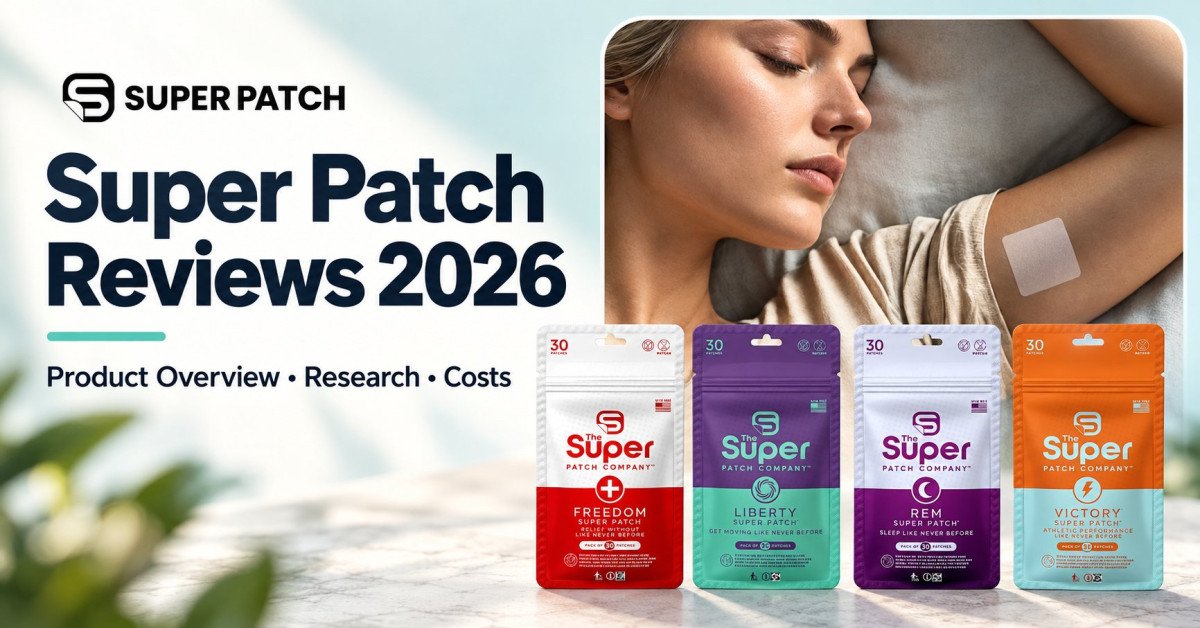
CHICAGO, October 17, 2026 (Newswire.com)
–
Disclosures. Affiliate links are included, and a commission may be earned from purchases. Product claims are attributed to the brand or cited studies. This review provides general information, not personal medical advice. The brand states that its patches are not intended to diagnose, treat, cure, or prevent disease.
View the current Super Patch pricing
Super Patch Reviews: Researching If SuperPatches Work? Studies, Costs & Side Effects (Consumer Research)
A closer look at Freedom, REM, and Peace research, reported side effects, current price examples, and the return-policy details that matter before checkout.
If an ad for Super Patch sent you looking for more information, you probably have a few practical questions. What is in the patch? What did the studies actually find? How much will an order cost, and can you return a pack after trying it? You should be able to find those answers without sorting through a sales pitch or a page of unexplained scientific terms.
Quick answer: Super Patch is a range of adhesive wearables that the company markets as drug-free, with a textured pattern rather than an active drug ingredient at the center of its proposed technology. Research exists on specific patches, but study designs and limitations differ. When reviewed, Freedom and REM were each listed at $99 for 30 patches in the U.S. store. Buyers should check the exact patch, delivery cost, skin precautions, and written return conditions before deciding whether the product fits their expectations.
Quick Verification Snapshot: October 16, 2026
- Product format: The company markets skin-contact patches using Vibrotactile Technology, commonly abbreviated VTT.
- Verified price examples: The official Freedom and REM product pages each displayed $99 for 30 patches.
- Evidence distinction: Product-specific publications exist; their findings cannot automatically be applied to every patch in the range.
- Return qualification: The written policy includes eligibility conditions, shipping exclusions, and a restocking fee for qualifying larger orders.
- Material limitations: This is a source-based editorial review, not a collection of original customer reviews. No hands-on testing or product-by-product regulatory determination was performed.
A small patch can raise several separate buying questions. You are choosing a specific product, weighing how it might work, paying the order total, and accepting the seller’s purchase terms. Each deserves a clear answer. A general impression of the brand cannot tell you whether a particular patch has relevant research or whether an opened pack will qualify for a refund.
The wearable format is central to the company’s offer. According to the company, its wearables let people pursue everyday wellness goals without an active drug ingredient. That proposition may interest people who prefer a wearable format or want to discuss an additional option with a clinician. However, the absence of an active drug is a product characteristic. It does not establish the size, reliability, or duration of a health benefit.
The most useful question is therefore specific: what evidence supports the exact patch and outcome you care about? A pain study does not establish an effect on sleep stages. A sleep questionnaire does not establish improved athletic performance. A proposed sensory mechanism does not, by itself, establish meaningful changes in daily life. Keeping those distinctions visible makes the research easier to assess.
The practical side can matter as much as the science. A displayed pack price may exclude shipping and tax. A general money-back statement may have narrower eligibility rules on the policy page. A recommendation to evaluate a product over time raises an obvious follow-up question: will opened or partly used packs qualify for a return? These are purchase questions worth resolving in writing.
This review examines the U.S. storefront, selected product listings, the brand’s FAQ and policies, and identified research publications. It distinguishes reported findings from promises and provides calculations and questions you can reuse. No personal experience with the patches is claimed. The aim is to help you decide with a clearer view of both the product and the remaining uncertainty.
Choosing one patch for a specific reason makes the comparison easier. Focus on the wearable format, the study relevant to your question, and the actual order total. You can then review the selected listing with a clearer sense of what you expect and what would make the purchase worthwhile to you. There is no need to decide on the entire range when your question concerns a single product.
What Is Super Patch?
Super Patch refers to a family of adhesive wearables sold by The Super Patch Company. You may also see the name written as SuperPatch in product discussions and search results. The brand describes the patch approach as contact-based wearable technology. It is presented differently from a medicated patch that delivers an active drug or a nutrient patch marketed around an ingredient dose.
The official Freedom listing identifies polyethylene adhesive patches measuring 1.5 by 1.5 inches. The REM listing describes the same listed size and pack count. Those are confirmed examples; they are not a substitute for checking the packaging of whichever product you order.
On the official website, different named patches are associated with different wellness goals. Freedom is positioned for minor aches and pains, REM for sleep, and Peace for calm. Product names describe the company’s positioning. They do not establish medical suitability for a particular person or diagnosis.
Buyer Takeaway: Start with the exact patch name. Evidence, directions, price, and purchase conditions should match that product rather than a general impression of the brand.
View the current Super Patch selection
How Does Super Patch Claim to Work?
Quick answer: Super Patch’s proposed mechanism involves a textured pattern contacting the skin and providing sensory input. The company connects this approach with mechanosensory pathways and PIEZO ion channels. That is the brand’s explanation; it does not establish that every patch produces a specific clinical outcome or that the complete mechanism has been demonstrated.
The company describes contoured ridges as the central feature of VTT. Its homepage explains a proposed sequence from skin contact to nervous-system signaling. That explanation raises a separate question: has the exact patch been shown to produce the advertised outcome under suitable study conditions? A description of sensory signaling cannot answer that question on its own.
Keep three questions separate when reviewing the explanation: does the underlying biological process exist, does the patch engage it as proposed, and does that engagement create a meaningful benefit? A reference that answers the first question does not necessarily answer the second or third.
Likewise, a scientific diagram can explain a hypothesis without measuring a user’s outcome. Useful documentation should identify what was tested, which patch was used, who participated, and what was measured. If the page only explains a possible pathway, you still need product-specific evidence for an outcome claim.
What Is in the Patches?
The brand describes Super Patch wearables as drug-free and says their proposed effects come from the physical pattern rather than added active ingredients. The accessible Freedom and REM listings identify an adhesive construction. Neither listing should be read as an ingredient-based supplement formula.
Knowing whether a patch contains an active drug is only part of understanding its materials. If you react to adhesives, ask for the relevant materials and allergen information before applying a patch. A statement that no active drug is added does not provide a complete adhesive formulation or establish individual tolerance.
The brand uses broad language about the absence of chemicals in its promotional materials. For a buying decision, ask the narrower question: which substances and materials are present in the adhesive, backing, and skin-contact surface? That gives you a more useful answer than treating a marketing phrase as a materials certificate.
According to the company’s FAQ, users should remove the patch and stop using it if irritation occurs. That advice matters even when an adhesive is described as hypoallergenic. The description does not mean every person will tolerate it, so check the package directions and ask about any material you know has caused a reaction before.
Check the selected patch’s listing
Freedom, REM, Peace, and the Wider Super Patch Range
The brand positions its range around different wellness interests. The homepage links Boost to energy, Victory to athletic performance, Liberty to balance and mobility, Focus to concentration, Joy to mood, and Peace to calm. These are brand-positioning summaries, not independently established outcomes.
Other homepage categories include Lumi for skincare, Assure for motion comfort, Zen for mindful clarity, Ignite for metabolism, Defend for immune support, Kick It for willpower, and Rocket for men’s wellness. This review does not independently evaluate each of those products or substantiate their advertised benefits.
Freedom and REM receive more practical attention here because their individual U.S. listings were checked for price, pack count, and construction. Peace appears in the research discussion because an identifiable publication evaluates that specific patch. None of these selections ranks or recommends combining products.
When you encounter a claim, write the patch name beside it. Then write the study name, outcome, and follow-up period. If you cannot find one of those details, make it a follow-up question. This simple check keeps a general statement about the brand from standing in for evidence about the patch you are considering.
Does Super Patch Work? What the Studies Can Tell You
Super Patch research is most useful when you keep the product, comparison, and measured result together. Three identified publications offer a starting point for that assessment. They are not interchangeable demonstrations of every benefit listed on the homepage. The following summaries separate the reported findings from the decisions those findings can reasonably inform.
Each paper answers a limited question about a particular group of people over a particular period. A favorable result can be worth considering while still leaving questions about longer use, a different symptom, or another patch unanswered. This review explains those boundaries; it does not add personal product experience to the published findings.
Freedom: the 2025 RESTORE pain study
The RESTORE publication describes 118 adults: 64 received the active Freedom patch and 54 received a similar-appearing placebo patch. The prospective, randomized, double-blind comparison assessed pain severity, interference with daily activities, and range of motion or flexibility at baseline, day seven, and day 14. Investigators reported results favoring the active patch.
The Pain and Therapy full text identifies limited sites, a small sample, short duration, and varied pain presentations as limitations. It states that the precise mechanism remains uncertain. Srysty Holdings funded the study and journal service fee. Investigators were compensated, and the research organization was paid to administer the study.
That is evidence about Freedom over the measured interval. It does not establish lasting benefit, superiority over medication, or effectiveness of the other named patches. Funding and compensation do not by themselves invalidate findings, but they belong beside the result when you weigh it.
Peace: the 2025 case-control comparison
The Peace publication describes 102 adults, with 65 in the active-patch group and 37 in the control group. It identifies a single-blinded case-control design and questionnaire assessments at baseline, day seven, and day 14. The authors report favorable findings on perceived stress and mental-health measures for the active-patch group.
The full paper supplied through the brand’s research library names Super Patch Company, Srysty Holding Co., under financial support and sponsorship. Its limitations discuss self-reported responses. The findings should not be characterized as independent replication or relabeled as the randomized design used in RESTORE.
A change in these questionnaires is not a guarantee that an anxiety disorder will improve for a particular buyer. This review does not recommend Peace as a substitute for psychological or medical care. Keep the paper’s measured outcome separate from a broader disease-treatment promise.
REM: the 2024 HARMONI observational study
The HARMONI sleep paper describes 133 adults: 113 active-patch users and 20 controls. The blinded, nonrandomized observational comparison used sleep questionnaires through day 14 and reported improvements for the active group. Its limitations include subjective reporting and unequal groups.
Srysty Holding Co. funded the study; investigator compensation and the research organization’s involvement are disclosed. The paper also reports unwanted effects, discussed in the safety section below. Questionnaire findings do not directly establish increased objectively measured REM-stage sleep. The product’s name does not measure that sleep stage.
The study provides short-term, self-reported observations about the REM patch. It leaves important questions about longer use and objectively measured sleep outcomes unanswered. Its findings do not predict your nightly response or establish suitability for every sleep problem. Keep those limits in mind when comparing the study with broader statements on a product page.
Turn the evidence into a question that matters to you
First, name the outcome you are actually trying to understand. Better comfort during an ordinary activity, feeling more rested, and receiving treatment for a diagnosed condition are different goals. Write your question in ordinary language, then compare it with the study’s measured outcome. If they differ, ask what evidence addresses the missing part rather than assuming the distinction is unimportant.
Next, consider the time period relevant to your decision. A short follow-up can address an early change; it cannot answer every question about months of use. If you are budgeting for repeated orders, that longer horizon matters. Ask what evidence supports the period you have in mind. The purchase plan should not silently extend beyond the evidence you rely on.
Finally, separate a scientific observation from your personal threshold for value. A reported improvement might not tell you whether a product is worth its price to you. Set that threshold before spending more on additional packs. A balanced decision can recognize a favorable finding, an unresolved question, and a personal budget at the same time. You do not need to turn uncertainty into either a promise or an accusation to make a careful choice.
If you bring the evidence to a clinician, make the question concrete: Does this study address the reason I am considering this exact patch, and what would count as a meaningful change for me? Include the product listing and your usual care plan. That gives the discussion a useful focus without asking a testimonial, a diagram, or a short research abstract to make an individual medical decision. You can leave with a clearer next question even when the evidence does not settle the purchase.
Buyer Takeaway: The strongest research question names one patch, one outcome, and a defined period. Keep the funding, study design, and limitations beside the findings rather than treating them as fine print.
How to Read a Research Percentage
A percentage in a research summary is incomplete without its denominator and comparison. Before interpreting a number as the benefit you might receive, identify exactly what changed and how that change was calculated.
For example, a hypothetical questionnaire score dropping from 10 to 7 represents a 30% reduction within that group. If a comparison group drops from 10 to 8, the two groups improved by different amounts. The first number alone does not tell you the difference attributable to the tested intervention. This arithmetic example is illustrative and is not a Super Patch study result.
Next ask whether the number describes an average score, a proportion of participants, or a difference between groups. Those are different measures. A change in a questionnaire score is also different from an objectively recorded sleep stage, a diagnosed condition resolving, or a person no longer needing medication.
The FTC’s Health Products Compliance Guidance explains that health advertising needs appropriate scientific support and that the overall advertising message matters. A citation is useful when its scope matches the actual claim. A citation can’t carry a stronger promise just because a study exists.
For a practical research check, save the paper title and record the patch, participants, comparison, measurement, and duration in one sentence. If a promotional claim is broader than that sentence, treat the extra breadth as a question rather than a confirmed fact.
Is Super Patch FDA-Approved? What Was Verified
The Super Patch website carries a disclaimer stating that its product statements have not been reviewed by FDA and that the products are not intended for disease diagnosis, treatment, cure, or prevention. This review does not assign an FDA device class or confirm clearance, approval, or exemption for any particular patch.
The distinction matters because a company listing, a product listing, a marketing authorization, and evidence of effectiveness answer different questions. FDA explains in its registration and listing guidance that registration and listing do not denote approval, clearance, or authorization.
If a seller gives you a regulatory description, ask for the exact product name and the document supporting that description. A general statement about the company or another product isn’t enough to confirm the item’s status in your cart. Avoid treating an official-looking certificate image as the answer without checking its source and meaning.
The same care applies to references to medical-grade materials. A materials description is not itself proof that a regulator has authorized all advertised health benefits. Your buying decision should keep product construction, regulatory status, and demonstrated outcomes as separate checks.
How Much Does Super Patch Cost?
Quick answer: Freedom and REM each displayed a U.S. price of $99 for 30 patches on October 16, 2026. That equals $3.30 per patch before shipping and tax. Your actual cost depends on the selected product, quantity, checkout charges, discounts, and usage; the displayed pack price is not a guaranteed delivered total.
The brand’s shipping policy lists a $6 per-order charge plus $1.50 per item. The following calculations assume that one pack counts as one shipping item and that the listed formula applies without a promotion. Confirm that assumption at checkout.
- One $99 pack: $99 + $6 + $1.50 = $106.50 before tax, or $3.55 per patch.
- Three $99 packs: $297 + $6 + $4.50 = $307.50 before tax, or approximately $3.42 per patch across 90 patches.
- Two different $99 packs: $198 + $6 + $3 = $207 before tax. If one patch from each pack is used per day, that is $6.90 per day across 30 days.
These are calculated purchase scenarios, not live cart quotes, recommended combinations, or claims that larger orders improve outcomes. A count of 30 patches supports 30 uses only if you use one patch once per occasion. It does not establish a universal monthly supply for every routine.
Buyer Takeaway: Compare the delivered cost with the particular outcome you want to assess. A lower shipping cost per patch does not make additional products necessary or improve the evidence for them.
Check purchase and return details
What Does the Return Policy Actually Cover?
The written refund policy is more qualified than a simple money-back headline. It states that most products can be returned within 30 days of delivery, requires original condition and packaging, excludes final-sale items, and makes return shipping the customer’s responsibility.
For eligible returns after shipment, the published policy excludes shipping and handling from the refund. A 10% restocking fee applies to refund requests for orders valued at $400 or more, excluding tax, shipping, and handling. Store credit may be used when we can’t refund the original payment method. Exceptions are at the company’s discretion.
The homepage’s broader guarantee wording leaves an important practical question: how does the condition requirement apply to opened or partly used packs? The reviewed policy does not clearly resolve that scenario. Ask the returns team before opening a pack, and retain its written answer. Do not assume that a product-evaluation suggestion overrides return eligibility.
Also request the return address and instructions before mailing anything. A corporate address is not automatically a return destination. No refund-processing interval or required return carrier is promised here because those details were not established in the reviewed policy. Seller terms should be read alongside applicable consumer rights; this review does not determine the legal outcome of an individual dispute.
Shipping, Cancellations, and Conflicting Deadlines
According to the shipping policy, dispatch generally occurs within one to two business days after payment confirmation. The stated delivery aim is three to seven business days, with up to ten for certain remote locations or small orders. These are seller estimates, not guaranteed arrival dates.
The shipping page permits cancellation with a refund, including shipping and tax, before dispatch. Once shipped, the return policy applies. Inspect your order confirmation for the actual shipping charge and selected products.
There is a deadline discrepancy worth recording. The refund policy requests reshipment contact within 15 days of the order date, while the shipping policy asks customers with lost, delayed, or damaged packages to contact support within 30 days of the expected delivery date. These are different starting points. This review does not decide which deadline controls a particular case.
Contact support promptly when a problem appears, provide the order and tracking details, and ask which procedure applies. Keep the response and avoid waiting on the assumption that the longer published period will cover your situation. The practical value is a dated record of the issue and the seller’s instructions.
How Should You Use and Evaluate a Patch?
The company’s FAQ advises applying it to clean, dry, unbroken skin and generally recommends single-use wear for up to 24 hours. REM has a different stated schedule: apply when preparing for sleep and remove on waking. Check the directions that come with the exact product.
For your own record, choose one ordinary goal and describe it before starting. You might record perceived restfulness or comfort during an activity you already consider appropriate. Keep your existing care plan in place; do not create a medication-withdrawal experiment to test a consumer product.
Keep the entries brief and use the same description of your goal each time. For example, if you are recording perceived restfulness, note what you noticed rather than assuming you spent more time in a particular sleep stage. Record unchanged or worse experiences as carefully as improvements. You do not need to continue using a patch through irritation or worsening symptoms to complete a record.
The log is a personal observation aid. It cannot establish causation or replace a controlled trial. If several things change together, record them rather than assigning every change to the patch. Discuss persistent symptoms with a healthcare professional instead of extending an informal test indefinitely.
Buyer Takeaway: Decide what you want to observe, keep a balanced record, and understand the purchase terms before opening the package. An evaluation period is not an obligation to continue through irritation or worsening symptoms.
Super Patch Side Effects: What Has Been Reported?
Anyone considering Super Patch for a health concern should distinguish an optional consumer purchase from diagnosis and treatment. An adult interested in the wearable format can discuss it with a clinician, especially when an existing condition, ongoing symptoms, or skin sensitivity makes suitability uncertain.
The REM HARMONI paper records five reports of side effects among 113 active-patch users: one each of lucid dreams, insomnia, itching, sleeplessness, and adhesive irritation. It reports no serious adverse events during the study. These reports do not establish causation or a population-wide risk rate; they reflect this study and this patch.
Both parts of that finding matter. Reported events need context, and a small, short study that records no serious events cannot establish safety for every user or pattern of use. If your sleep becomes worse or your skin reacts, record what happened and seek appropriate advice rather than treating the product’s drug-free description as an answer.
The brand’s FAQ acknowledges that adhesive reactions can occur and advises removing the patch and stopping use if irritation develops. Its use instructions exclude open wounds and sensitive or damaged areas. If you have a relevant allergy history, ask for materials information rather than relying on broad reassurance.
This review does not independently establish suitability during pregnancy or breastfeeding, for children, or for people with implanted devices. Those questions require an appropriate clinician and product-specific documentation. An exclusion from a research study does not, by itself, prove a contraindication; it does limit what that study can tell you about the excluded population.
People seeking a guaranteed outcome, a replacement for prescribed care, or a proven solution for a diagnosed disorder should not interpret the wellness descriptions as providing those assurances. Feeling better after using a patch also does not establish that an underlying condition has resolved.
How to Read Super Patch Reviews and Recommendations
Reviews and professional endorsements can highlight experiences and raise questions, but they do not replace evidence supporting a specific health claim. The brand materials reviewed for this article display a 4.8 rating alongside more than 24,000 reviews. These are company-reported figures, separate from ratings or review counts on any outside platform. Ratings reflect brand-reported customer data; individual experiences and results vary. The aggregate was not independently audited for this review.
The brand reports recommendations from thousands of doctors and presents a scientific and performance advisory team. Neither the overall count nor the scope of each recommendation was independently established here. The listed professional groups include different disciplines; the word doctor should not be read as meaning that every endorser is a physician. A name on an advisory page should not be read as an independent regulator’s finding or as proof that the professional recommends every patch for every advertised use.
For a useful review check, separate product experience from ordering experience. Ask whether the reviewer identifies the patch, length of use, and outcome. For a delivery or refund complaint, ask what was ordered and what policy applied. A single account cannot establish a typical result or the frequency of a problem.
No individual testimonial is reproduced as proof of benefit in this article. Media appearances and conference presentations are also different from an independent clinical recommendation. Ask what the underlying publication actually tested rather than inferring endorsement from a logo or event name.
Is Super Patch Legit, and Where Can You Buy It?
Super Patch has an identifiable official storefront, named products, published policies, and customer-support channels. Those observations help establish what is being offered. They do not guarantee effectiveness, suitability, fulfillment, or a refund in an individual case.
The terms of service name The Super Patch Company Ltd LLC for customers in the United States, United Kingdom, and Canada. The site’s footer uses The Super Patch Company LLC. Both forms are reported as displayed; this review does not independently resolve their corporate relationship.
Use the official U.S. storefront and check the final destination when following a referral link. Confirm the product name, pack count, currency, order total, and payment arrangement. Confirm whether you are authorizing a one-time or recurring purchase; a complete checkout and recurring-payment audit was not performed for this review. Cenerx is the affiliate referral route provided, separate from the official U.S. storefront linked above.
Before paying, save the product listing and policy version relevant to your purchase. Read any recurring billing language displayed during checkout and distinguish an optional marketing-email signup from payment consent. The receipt and checkout terms, rather than a review’s general description, should document the transaction you authorized.
A Practical Checklist Before You Order
Before opening checkout, write down three things: the exact patch, the question you want its evidence to answer, and the amount you are comfortable spending. Then check the following against the current listing and written policies:
- Product match: Does the study concern the same patch you plan to order? A publication about Freedom should not be used as the answer to a question about REM or Peace.
- Outcome match: Did researchers measure the change that interests you, or are you relying on a broader marketing description? Check whether the measure was a questionnaire, a physical assessment, or another type of observation.
- Total cost: Confirm the number of packs, shipping, tax, and any payment arrangement. Save the final amount before authorizing the order.
- Return eligibility: Ask specifically about an opened or partly used pack, not just whether a money-back guarantee exists. Include the order value when asking about possible deductions.
- Your circumstances: Check the package instructions and raise any relevant symptom, skin sensitivity, or suitability question with an appropriate healthcare professional.
This checklist does not determine whether a product will work for you. It gives you a consistent way to compare the offer with the evidence and terms. You can use it to pause an unclear purchase, ask a focused question, or decide that you have enough information to make your own choice. None of those decisions requires a guaranteed outcome or a recommendation to buy several patches at once.
Frequently Asked Questions About Super Patch
Does Super Patch really work?
No single answer covers every patch and every advertised outcome. Identified publications provide product-specific findings with different strengths and limitations. Your question should name the patch and intended result. Then check whether the study measured that result, used a suitable comparison, and followed people long enough to answer your concern. Individual improvement is possible without being guaranteed, and no personal outcome is promised here. If you are considering a patch because of ongoing symptoms, discuss the symptoms and the evidence with your clinician before treating a purchase as a care decision. Bring the actual publication or link so the discussion addresses the same evidence.
Is Super Patch a medicine or a supplement?
The reviewed patch listings describe adhesive wearables marketed around a tactile pattern, rather than an active drug or nutrient formula. Do not confuse that format with another item sold by the same company or with unrelated medicated patches. The relevant questions are what the exact item contains, what it claims to do, and what documentation supports those claims. This review does not independently assign a regulatory classification. If a seller describes a particular patch as registered, cleared, approved, or exempt, request product-specific supporting documentation and verify what the term actually establishes. Keep the exact listing and package information together for any follow-up questions you raise.
Is Super Patch FDA-approved?
No product-specific FDA approval or clearance is confirmed by this review. The company’s own website carries an FDA-related disclaimer, and its general marketing should not be interpreted as proof of regulatory authorization. FDA’s registration guidance distinguishes a database listing from approval or clearance. That distinction also means a company registration number would not, by itself, answer the question. Ask the seller for the exact product name, claimed status, and corresponding official record. Avoid replacing one unverified assumption with another about how a product must be classified because it is sold without a prescription. Save any documentation supplied so its product match and source can be checked later.
Can Super Patch cause side effects?
Yes, unwanted effects have been reported, although a report does not establish that a patch caused the event. The company acknowledges possible adhesive reactions and advises removing the patch and stopping use if irritation occurs. The REM HARMONI paper also records five side-effect reports among 113 active users: lucid dreams, insomnia, itching, sleeplessness, and adhesive irritation. It reports no serious adverse events during its short follow-up. Those findings do not establish the frequency of effects among all users. Follow the exact package directions, ask about materials if you have known sensitivities, and seek medical advice if a reaction persists or concerns you. Record the patch name and timing so you can describe the experience clearly.
How long should one pack last?
The verified Freedom and REM examples contain 30 patches. At one single-use patch per day or night, that count supports 30 applications. Using more patches consumes the pack sooner, while less frequent use changes the calendar duration. A pack count therefore should not be treated as an unconditional monthly supply promise. Decide which routine the product instructions support, then calculate the cost of that routine. Do not reuse a patch to stretch the budget against the brand’s single-use directions, and do not assume combining patches is necessary merely because the brand sells several options. Recalculate your expected usage before buying several packs on the assumption of better value.
Can I return a partly used pack?
The reviewed written policy requires original condition and packaging but does not clearly explain how this requirement applies to every opened or partly used pack. A broad guarantee headline does not settle that question. Contact the returns team before purchase, name the exact item, and ask for written confirmation of eligibility after partial use. Also ask what must be returned and when the request must be made. Keep the reply with your receipt. This review cannot promise that a particular opened pack will qualify or that shipping charges and other applicable costs will be refunded. Request clarification while you can still choose whether the purchase conditions suit your plans.
Should I stop my current treatment to try a patch?
Do not change prescribed treatment on the strength of a product advertisement, testimonial, or this review. Bring the exact patch information and research to the clinician managing your care. Discuss an optional wearable separately from whether an established treatment remains necessary. Changes in symptoms should be interpreted in the context of your health history, other treatments, and appropriate assessment. If your care plan changes, record that change separately from patch use so you do not mistakenly attribute the result of several simultaneous changes to one consumer product. Your clinician can help separate a product preference from a change in medical management.
What should I confirm at checkout?
Confirm the patch name, number of packs, patches per pack, currency, item subtotal, shipping, tax, and final amount. Read the payment arrangement and any recurring terms rather than assuming the absence or presence of a subscription. Check which seller processes the transaction and which policy applies. Save the receipt and return conditions, especially if support has provided clarification about opened products. If the checkout total differs from a calculation in this review, rely on the current disclosed terms and resolve the difference before authorizing payment. Examples here are not binding cart quotes. Take time to resolve an unclear charge rather than relying on a headline price.
Super Patch Contact Information and Customer Support
The official contact page provides a U.S./Canada telephone number and support email. The separate returns policy provides an email address for return requests; it should not be confused with a physical return destination. Use the channel that matches your question, and keep the response.
- General support: support@superpatch.com.
- U.S./Canada phone: 1-844-550-8699.
- Listed support hours: Monday through Friday, 8:30 a.m. to 5 p.m. EST, as stated on the contact page.
- Returns, exchanges, and reshipment requests: returns@superpatch.com.
- Listed corporate office: Unit 1, 350 Britannia Road East, Mississauga, Ontario, L4Z 1X9, Canada. Obtain separate return instructions before sending a package.
Include your order number, selected patch, date of purchase, and a short description of the question. For an unresolved policy issue, ask the team to state which policy provision applies. This creates a more useful record than relying on a general promotional statement.
Should You Try Super Patch?
Super Patch is a purchase to evaluate by exact product, evidence, cost, and terms. Its wearable format may appeal to an adult interested in discussing a drug-free option, but the available information does not justify a guaranteed outcome or a replacement for medical care.
Before deciding, identify the patch, check whether its research addresses your question, calculate the likely order total, and clarify the return terms. If you are considering it because of symptoms or a diagnosed condition, bring those details to your clinician. You can then decide whether the cost and remaining uncertainty fit your expectations. If a key answer is missing, ask for it before buying or opening a pack.
View current product information
Disclosures and Material Limitations
- FDA and health disclosure: The brand’s website states that its product statements have not been reviewed by FDA and that the products are not intended to diagnose, treat, cure, or prevent disease. No product-specific approval, clearance, device class, or exemption is established by this review.
- FTC affiliate disclosure: This paid advertorial contains affiliate links. A commission may be earned from qualifying purchases. That material connection should be considered when evaluating the content. Disclosure does not substitute for substantiation of health claims.
- Results variability: Outcomes vary. Brand-reported ratings, advisory relationships, and individual experiences do not establish a typical clinical result. No outcome or response time is guaranteed.
- Medical advice: Educational information is provided without diagnosis or individual treatment advice. Consult a licensed healthcare professional about symptoms, suitability, and changes to care. Do not discontinue prescribed treatment based on promotional content.
- Pricing: Selected U.S. listing prices and policies were checked on October 16, 2026. Calculations are illustrative, exclude tax, and assume the published shipping formula applies with each pack counted as one item. Read current checkout terms before purchase; seller terms do not displace applicable consumer rights.
- Editorial limitations: No hands-on use, independent laboratory testing, completed purchase, refund test, or comprehensive regulatory database audit was performed. Selected publications were reviewed; an exhaustive systematic review of every patch was not conducted. No transaction-based affiliate-attribution test was performed.
- Retailer and platform separation: Ordering, product fulfillment, and returns are handled by the seller under applicable terms. Hosting or distribution of this advertorial does not establish medical endorsement. Product development is attributed to the brand; content creation does not establish a role in product formulation.
- California consumers: Review the packaging and official site for any applicable Proposition 65 warning. No determination of warning obligations or product testing for listed substances is made here. California-specific questions should be directed to the seller; general information is available from the California Office of Environmental Health Hazard Assessment.
- Geographic and jurisdiction disclosure: This review addresses the U.S. storefront. Availability, seller identity, pricing, and terms can differ by region. No legal conclusion about enforceability of the seller’s terms or individual consumer rights is provided.
- No diagnosis or treatment assurance: Wellness descriptions should not be interpreted as a diagnosis, a disease-treatment promise, or evidence that medical assessment is unnecessary.
- Information can change: Prices, availability, policies, and research may change after October 16, 2026. Later developments are not represented as established facts in this review.
- Trademark acknowledgment: Super Patch and the product names mentioned belong to their respective owners. No registered-mark ownership determination was completed. References identify the products discussed and do not establish endorsement beyond the disclosed marketing relationship.
SOURCE: Super Patch
Source: Super Patch