


I don’t know what Shakespeare did — or if he did anything more than live a life with the usual collateral damage — but his late plays make it clear that, as mortality appeared on the horizon, he was thinking a lot about forgiving and being forgiven. Cymbeline, The Tempest, and perhaps most of all The Winter’s Tale turn on questions of grace and redemption. All of them feature hardheaded men who do terrible things, or who, in the case of The Tempest’s Prospero, fixate on revenge for past wrongs. All of them are concerned with legacy, particularly among fathers and daughters (Shakespeare had two and lost his only son), and all of them touch a realm beyond the mundane — a place of gods and dreams, oracles and enchantment. Part of their implication is that some crimes are so awful that it would take a miracle to forgive them, and also, we must believe in miracles.
Paulina, a not-to-be-messed-with lady-in-waiting in The Winter’s Tale, puts it this way: “It is required / You do awake your faith.” She is, as always, right: It is required, whether you’re trying to heal or sitting down to watch a play. The climactic scene in which Paulina conjures us with these words is one of the most breathtaking in Shakespeare. Leontes, the king of Sicilia, has baselessly accused his wife, Hermione, of adultery, and the consequences have been dire. He has lost his young son, his new baby, and the queen he once loved — that’s Acts One through Three — and then the play jumps to another country and 16 years forward. Its final act closes the circle, bringing the action back to Sicilia and to the grieving king, whom Paulina presents with a statue of his lost queen. “Would you not deem it breathed?” Leontes stammers, “And that those veins / Did verily bear blood? … The fixture of her eye has motion in’t, / As we are mock’d with art.”
It’s a scene with the power to split the heart and enlarge the soul, and it’s typical of Daniel Sullivan’s new production at the Delacorte, this summer’s second Shakespeare in the Park, that here its incandescence feels … not missing, entirely, but notably dimmed. When it comes to Shakespeare, Sullivan is competent and unadventurous. It’s not the worst possible sin — these days, it’s frankly refreshing to hear three hours and 20 minutes of Shakespeare spoken with real textual clarity and fluency across a whole ensemble and for that considerable runtime not to drag. That’s appreciable, and propelling this Winter’s Tale’s legibility is a cast full of undeniably excellent actors. Yet despite glimmers throughout, it doesn’t spark. Despite its title, this is a play full of heat — its story swirling through jealousy and brutality, sexy young love and wracking grief — yet on the Delacorte stage, it feels chilly and underenergized, a bear that’s a little too close to torpor.
Speaking of bears! One of the pleasures of The Winter’s Tale is waiting to see how a production handles the immortal stage direction “Exit, pursued by a bear.” It’s one of those touchstones — like Macbeth’s witches — that teach us a lot about the specific tone and texture of the play-world. It’s telling, then, that if you look down at your program at the wrong moment, you could miss this show’s bear entirely. Cast as a shadow on a billowing backdrop of sail-like cloth at the back of Maruti Evans’s set, it gets us all excited and then evaporates. It is, in fact, a microcosm for Sullivan’s production: Everything technically works, but there’s also the persistent deflation that comes with missed potential.
This phenomenon doesn’t spare the play’s leads, who often seem stuck, unstretched, or, in the case of Lily Rabe’s amped-up Hermione, prone to compensating for a general sense of energy imbalance. As the wronged queen, Rabe — who has played multiple heroines for Sullivan — strains in moments when she might more potently stand firm, shaking and screaming where a quiet word, girded up by all the same emotion, might do devastating wonders. It may be an attempt, conscious or not, to fill a gap: Across from her, the eminently likable Raúl Esparza makes for an unusually light Leontes. Casting against type is sometimes revelatory, and the thoughtful and comically sharp Esparza catches the bitterly ironic smiles in much of the king’s tormented soliloquizing. But he’s also clearly looking for ways to release into the full scale — of aggression, of misery, of eventual repentance and awe — that the part demands, and right now he’s still underplaying the tough material in moments that crave a fuller, more fearsome expression.
When we meet the king of Sicilia at the start of the play, he’s already scratching at an itch in his brain: Has his wife cuckolded him with his best friend, the visiting king of Bohemia, Polixenes (Gilbert Owuor)? Who’s the father of the baby she’s about to deliver? Or of his young son, Mamillius (Matthew Eby)? Part of the challenge of Leontes is that his jealousy seemingly comes from nowhere: It’s a senseless and deadly malady, random as a virus, debilitating as a tumor. “Good my lord,” the shrewd counselor Camillo (Teagle F. Bougere) pleads with him, “be cured / Of this diseased opinion.” Leontes has cancer of the soul, and only tragedy will eventually carve it out of him.
Esparza does find some lovely things in the quiet: When Polixenes speaks of their boyhood innocence, the twinges in Leontes’s face suggest that perhaps his suffering is rooted in a corrupted nostalgia, and that the character may be projecting his own weary guilts and shames onto his wife. That’s a compelling idea — and it also flickers out before long. There is, overall, an evanescent quality to Esparza’s king: The possibility of more and deeper keeps passing over his face like a shadow. He probably could take us to hell with him, but Sullivan doesn’t ask him to. At the play’s midway pivot, Hermione’s excruciating trial scene, he feels muffled and hemmed in while Rabe yells. A dynamic has gotten flipped somewhere, possibly in our frequently miscalculated efforts to empower Shakespeare’s plenty powerful women, or in our contemporary anxieties around letting male characters be as brutal as they sometimes are, especially if we eventually need to forgive them.
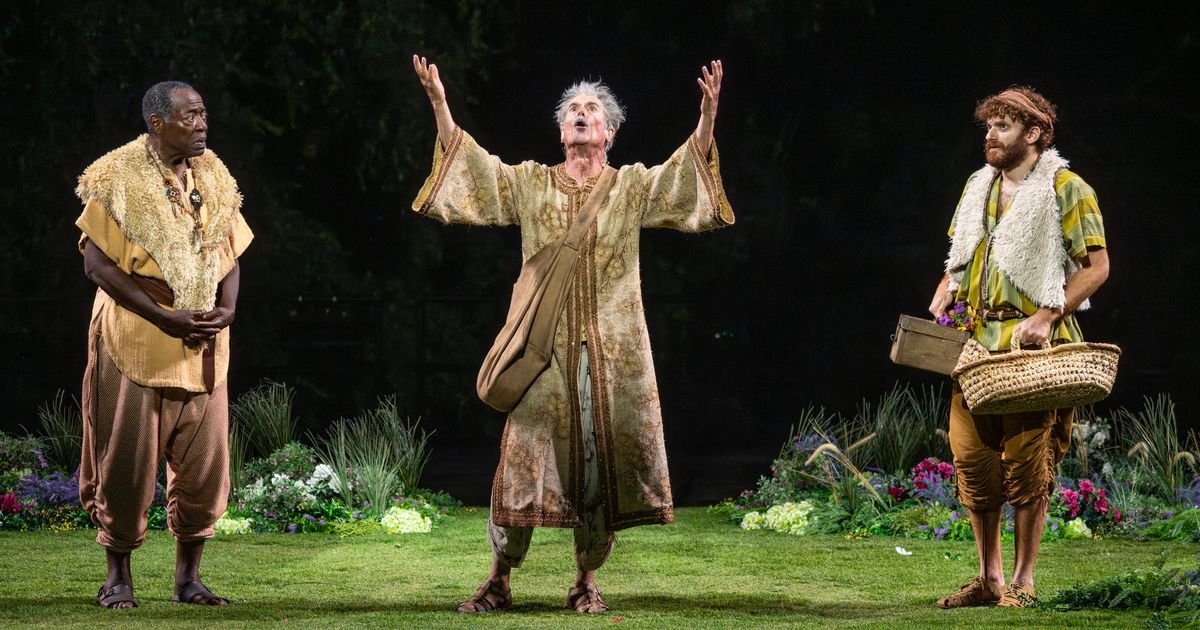
A subtle but still evident skepticism around that core idea of forgiveness is part of what dampens the production as a whole. It’s a coldness that even seeps into scenes that should be utterly delightful. When The Winter’s Tale leaps forward in time, the action moves to Bohemia (home to that hungry bear) and follows the abandoned, now-teenage daughter of Hermione and Leontes. Perdita (Isabela Ferrer), adopted in infancy by two sweet swains (the lovely Chuck Cooper as dad, Michael Khalid Karadsheh as son) doesn’t know that she’s more than a “shepherd’s daughter.” For now, she’s crowned in flowers and playing “mistress of the feast” at a sheep-shearing festival while her secret boyfriend — King Polixenes’s son, Florizel (Daniel Kyri), disguised as a fellow shepherd — looks lovingly on.
The play’s Bohemian rhapsody is as full of light and life and silliness as its time in Sicilia is wrenching. Indeed, tonal shift and contrast is one of The Winter’s Tale’s chief challenges and also its chief joys: Heinous acts sit in close proximity to hilarious ones (many perpetrated by a rogue called Autolycus, played by the gem Steven Skybell with “Comedy Tonight” relish). Ribald comedy interweaves with serious pain and loss. Yet instead of granting both their scope, Sullivan tends to let these extremes slide toward a middle ground. When Perdita and Florizel enter the field of flowers that adorns the stage after the jump to Bohemia, the actors cling so tightly to the text’s surface tensions that they lose the full breadth of their circumstances: Perdita is nervous about people discovering Florizel’s dalliance — and she and this big-hearted kid are also in love, surrounded by flowers and springtime and music, and about the go to a party. Here, though, the chill pervades: Ferrar furrows her brow and plays the negative for the entire scene — no chemistry develops; the love and the fun that are encountering a hurdle are missing and only the obstacle remains. The thinking is too literal: We don’t lose the play’s story, but we’re deprived of its glorious wholeness.
We also end up watching an ensemble muscle their way through unnecessarily awkward moments of textual adherence: Black actors having to praise people’s white hands; a real bummer near the end where Leontes hits on his own daughter before he knows who she is — why keep this stuff when you’ve made cuts elsewhere? And, to top it off, we’re hit with a parade of truly underwhelming costumes. A little bit fantasy, a little bit The Odyssey, and a lot-bit JoAnn Fabrics (RIP), the solid-hue, gold-trimmed tunics Linda Cho has draped over most of the ensemble read like a throwback to mid-century designs. Yes, the play trades in Mediterranean myth and fairy-tale motifs, but the looks here feel less inflected with magic and more generally old-timey Greek-ish: again, a literal reading of certain aspects of the text, like its references to Delphi and Apollo.
Just because these people believe in ancient gods and perhaps even in miracles doesn’t mean they have to look like extras from Disney’s Hercules. It doesn’t mean that their souls aren’t still our own. The more cynicism thickens the air we breathe, the more Paulina’s vital exhortation becomes. We must awake our faith — in the greater potential not only of our hearts, but of the art that we make about them.
The Winter’s Tale is at the Delacorte Theater through August 23.